Same Answer, 725× Cheaper. Same Bill.
By Michael Mancuso · October 14, 2026 · Originally published on LinkedIn
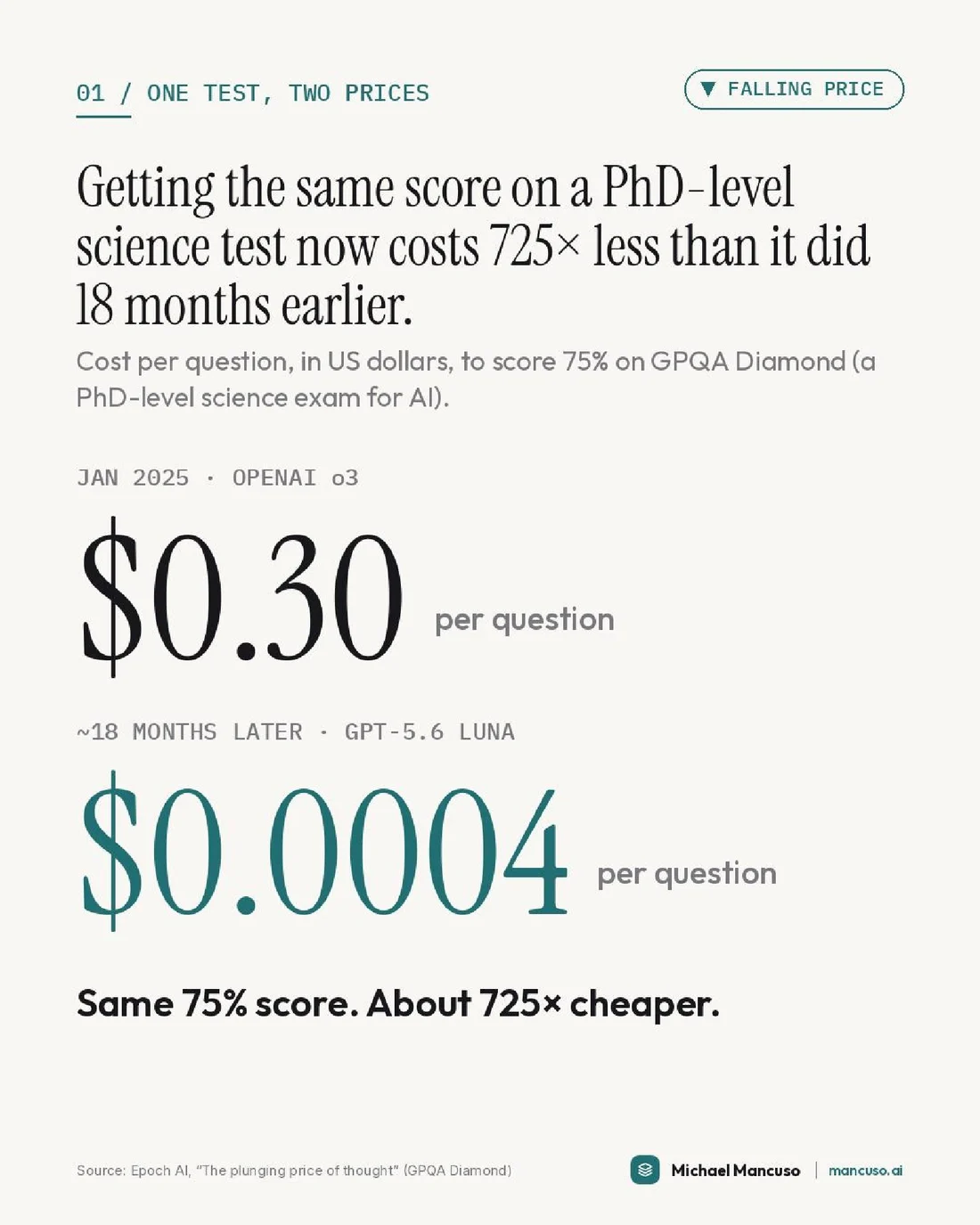
In January 2025, getting an AI to score 75% on a PhD-level science test cost about thirty cents a question. Eighteen months later, according to Epoch AI, you could get the same score for four hundredths of a cent. Roughly 725 times cheaper.
Electricity got cheaper at about 5% a year. Batteries, 16%. Computing, about 1.5 times a year for six decades. A fixed level of AI capability is getting about 13 times cheaper every year.
So why is nobody’s AI bill shrinking?
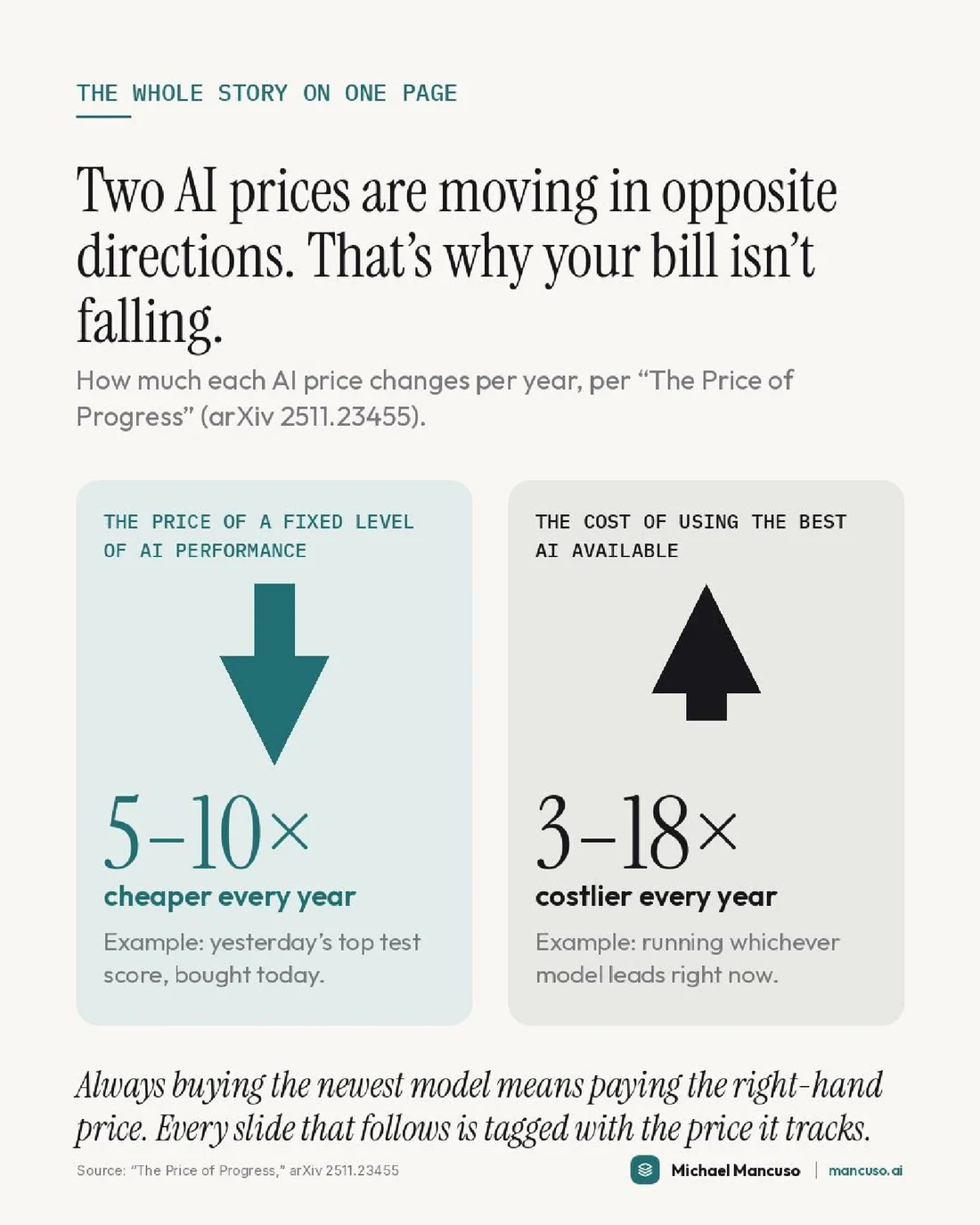
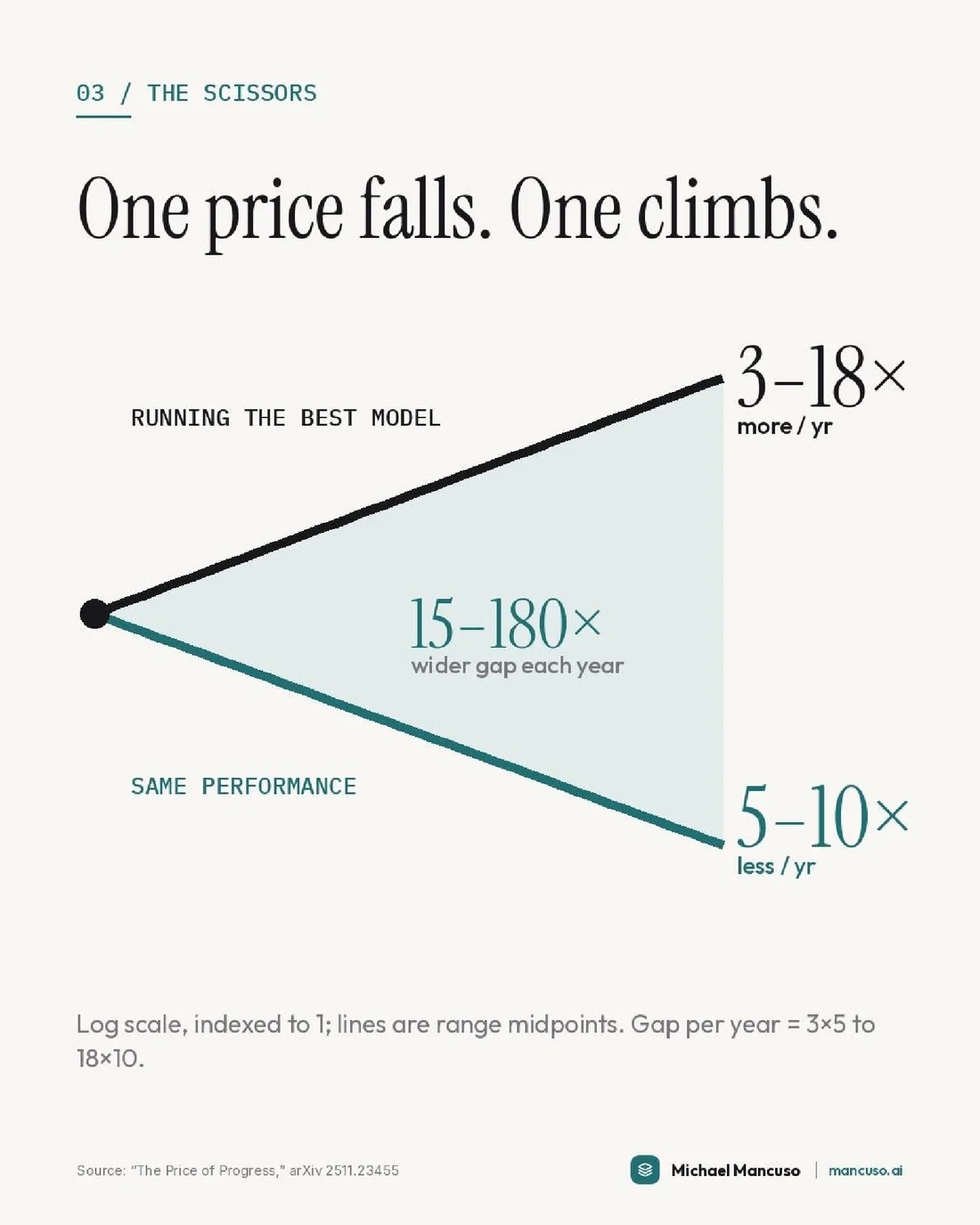
Because nobody buys a fixed level of capability. We buy the best one. And a separate study finds the cost of running the best available model has risen about 3 to 18 times a year, even as the price of yesterday’s performance falls 5 to 10 times.
It’s the same reason a new phone costs what it does, even though last year’s phone is now nearly free. The price of a thing falls. The price of status doesn’t.
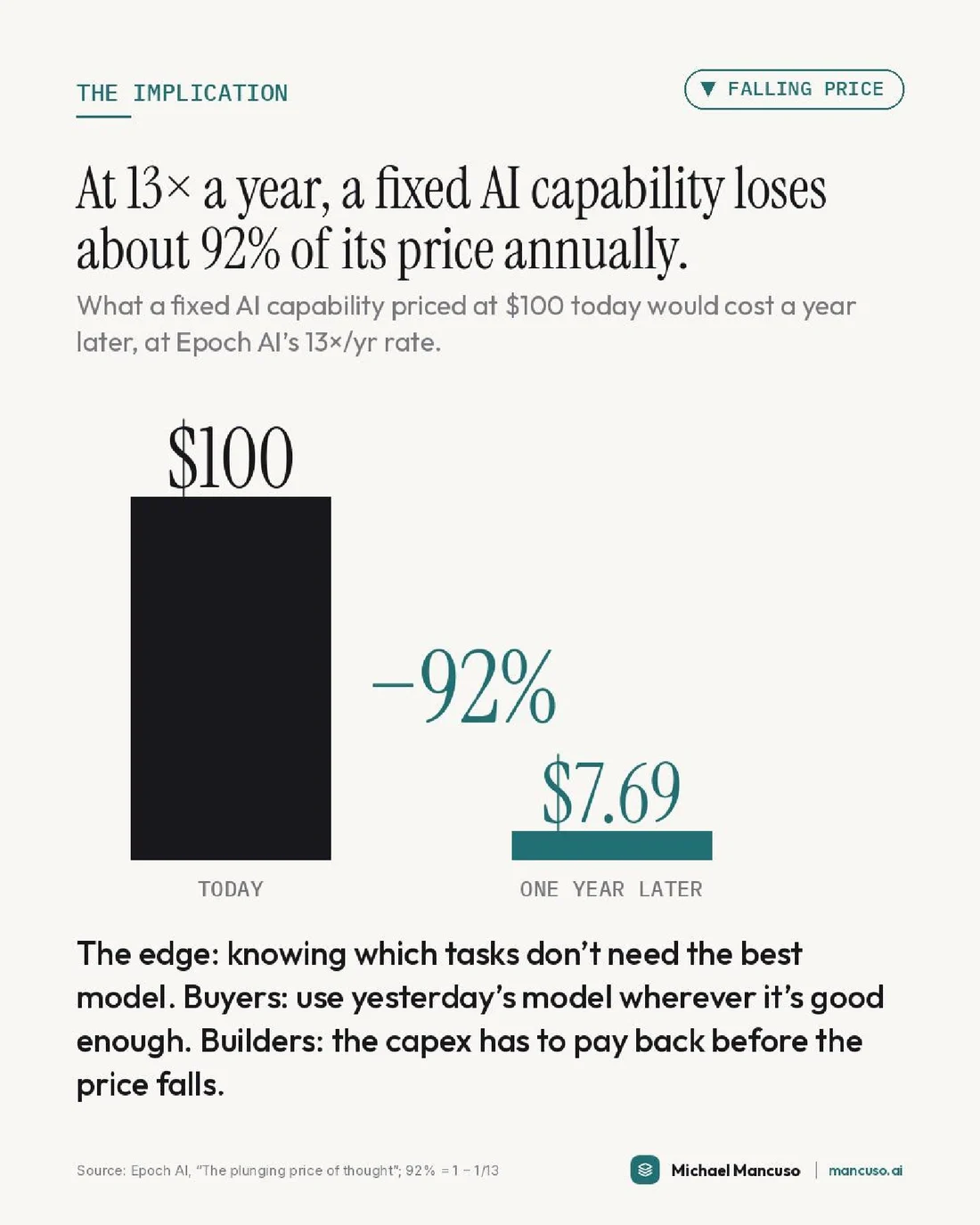
This is wonderful news for buyers who know which jobs don’t need the frontier. It’s harder news for builders. At 13 times a year, a product loses about 92% of its price annually. The capex has to pay back before the price does.
The real skill now is knowing when you don’t need the best model.
Read slide text
Slide 1
The AI cost paradox.
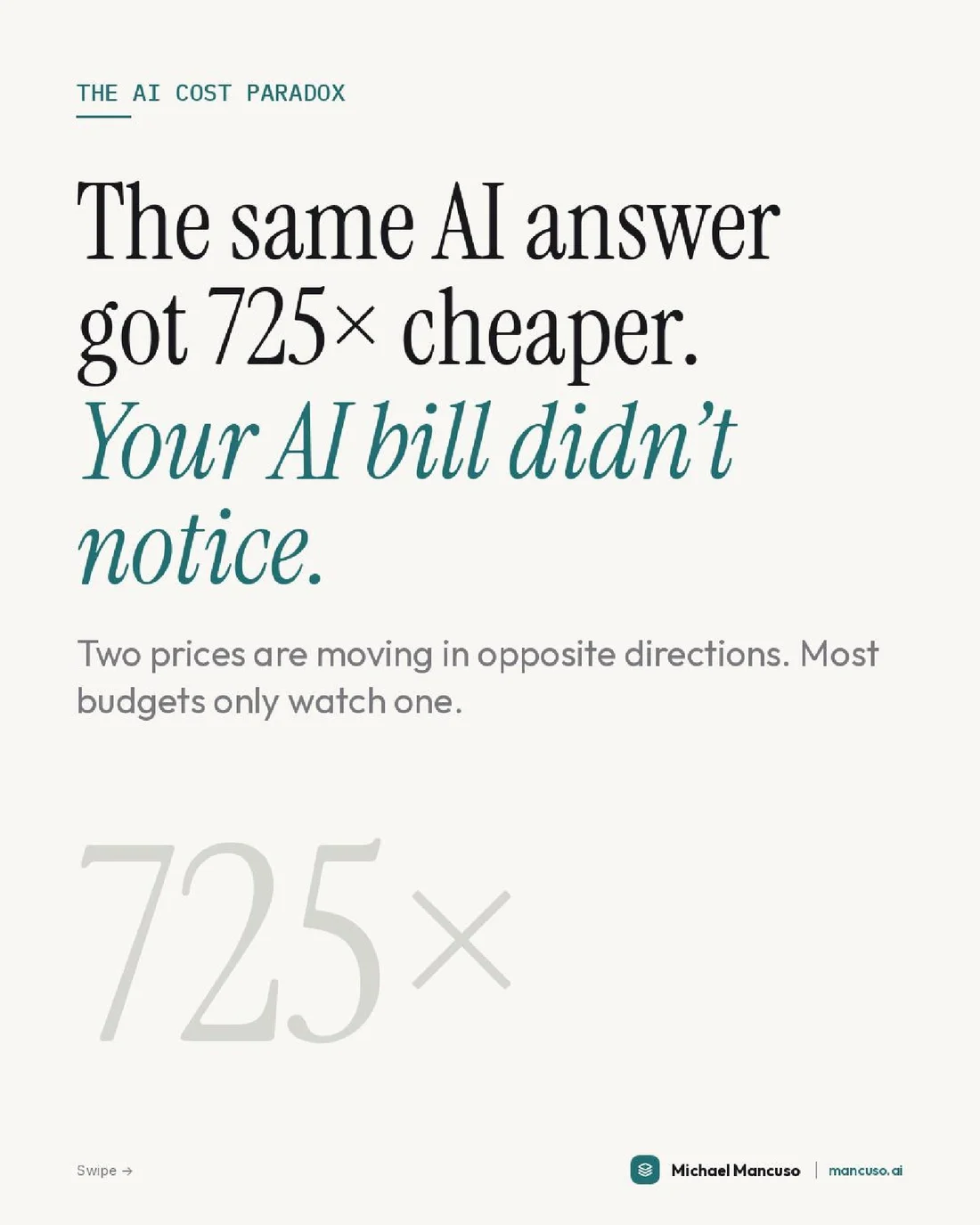
The same AI answer got 725× cheaper. Your AI bill didn’t notice.
Two prices are moving in opposite directions. Most budgets only watch one.
Slide 2
The whole story on one page.
Two AI prices are moving in opposite directions. That’s why your bill isn’t falling.
How much each AI price changes per year, per “The Price of Progress” (arXiv 2511.23455):
The price of a fixed level of AI performance: 5–10× cheaper every year. Example: yesterday’s top test score, bought today.
The cost of using the best AI available: 3–18× costlier every year. Example: running whichever model leads right now.
Always buying the newest model means paying the right-hand price. Every slide that follows is tagged with the price it tracks.
Slide 3
One test, two prices. Falling price.
Getting the same score on a PhD-level science test now costs 725× less than it did 18 months earlier.
Cost per question, in US dollars, to score 75% on GPQA Diamond (a PhD-level science exam for AI): January 2025, OpenAI o3, $0.30 per question. ~18 months later, GPT-5.6 Luna, $0.0004 per question.
Same 75% score. About 725× cheaper.
Slide 4
How fast is 13×? Falling price.
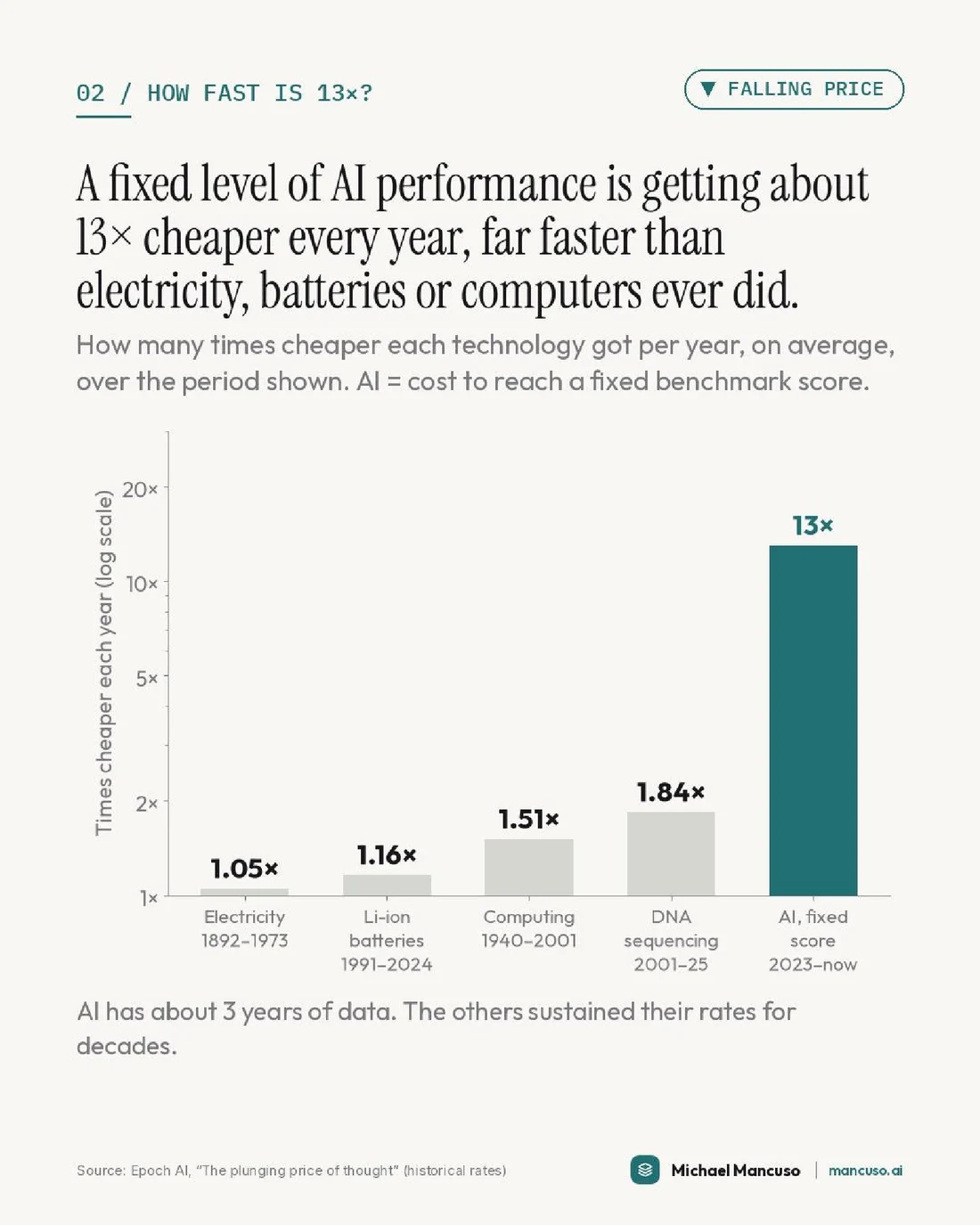
A fixed level of AI performance is getting about 13× cheaper every year, far faster than electricity, batteries or computers ever did.
How many times cheaper each technology got per year, on average, over the period shown. AI = cost to reach a fixed benchmark score.
Electricity (1892–1973): 1.05×. Li-ion batteries (1991–2024): 1.16×. Computing (1940–2001): 1.51×. DNA sequencing (2001–25): 1.84×. AI, fixed score (2023–now): 13×.
AI has about 3 years of data. The others sustained their rates for decades.
Slide 5
The scissors.
One price falls. One climbs.
Running the best model: 3–18× more/year. Same performance: 5–10× less/year. 15–180× wider gap each year.
Log scale, indexed to 1; lines are range midpoints. Gap per year = 3×5 to 18×10.
Slide 6
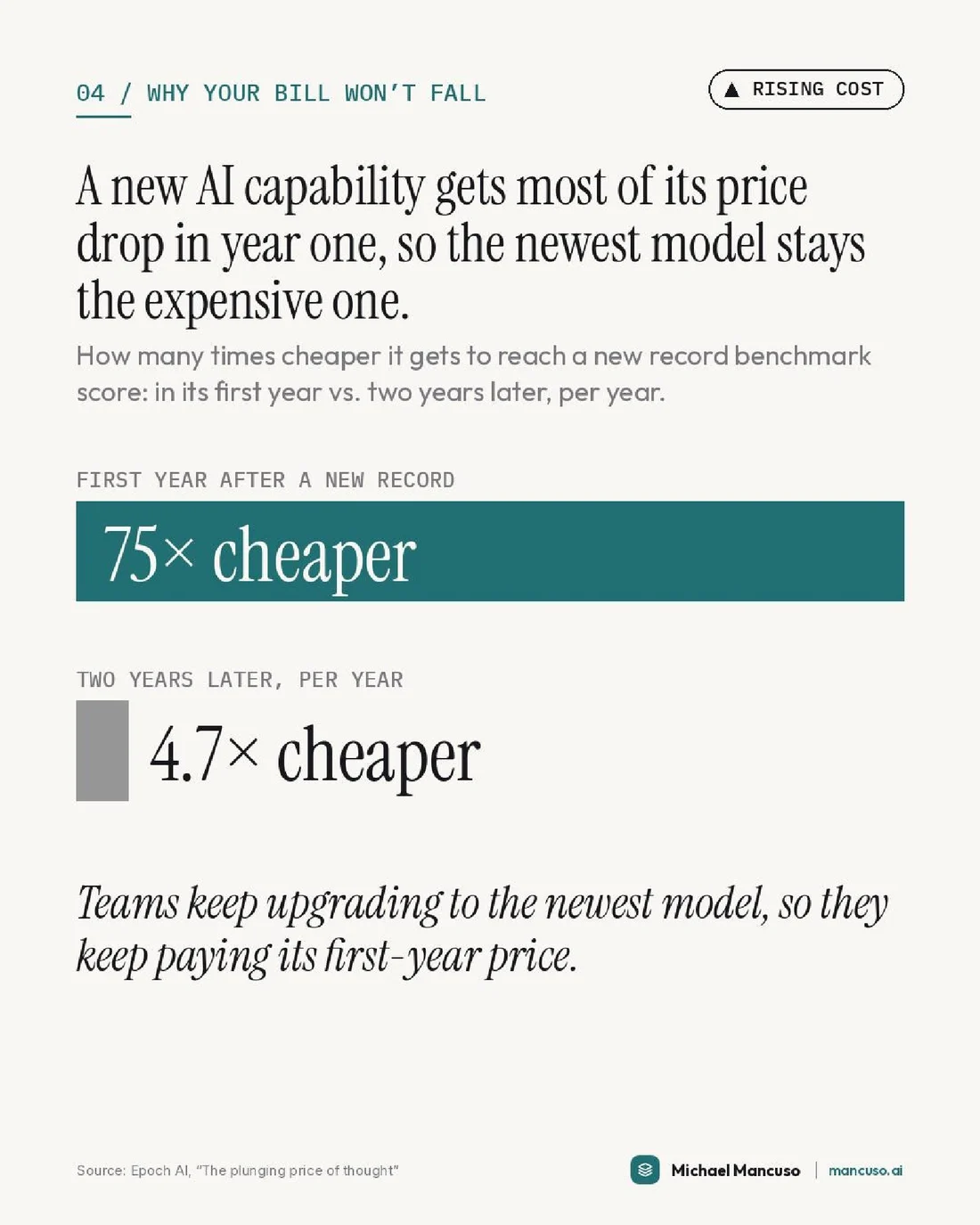
Why your bill won’t fall. Rising cost.
A new AI capability gets most of its price drop in year one, so the newest model stays the expensive one.
How many times cheaper it gets to reach a new record benchmark score: in its first year vs. two years later, per year.
First year after a new record: 75× cheaper. Two years later, per year: 4.7× cheaper.
Teams keep upgrading to the newest model, so they keep paying its first-year price.
Slide 7
The implication. Falling price.
At 13× a year, a fixed AI capability loses about 92% of its price annually.
What a fixed AI capability priced at $100 today would cost a year later, at Epoch AI’s 13×/yr rate: $100 today → $7.69 one year later. −92%.
The edge: knowing which tasks don’t need the best model. Buyers: use yesterday’s model wherever it’s good enough. Builders: the capex has to pay back before the price falls.
92% = 1 − 1/13.
Sources cited in the slides: “The Price of Progress,” arXiv 2511.23455; Epoch AI, “The plunging price of thought.”