Skip to content
Writing

How I think about
building with AI.

My writing and LinkedIn contributions, newest first. Explore the original posts and swipe through their carousels.

Free things never get a job description., page 1 of 5
Free things never get a job description., page 2 of 5
Free things never get a job description., page 3 of 5
Free things never get a job description., page 4 of 5
Free things never get a job description., page 5 of 5
1 / 5

Free things never get a job description.

Free things never get a job description.

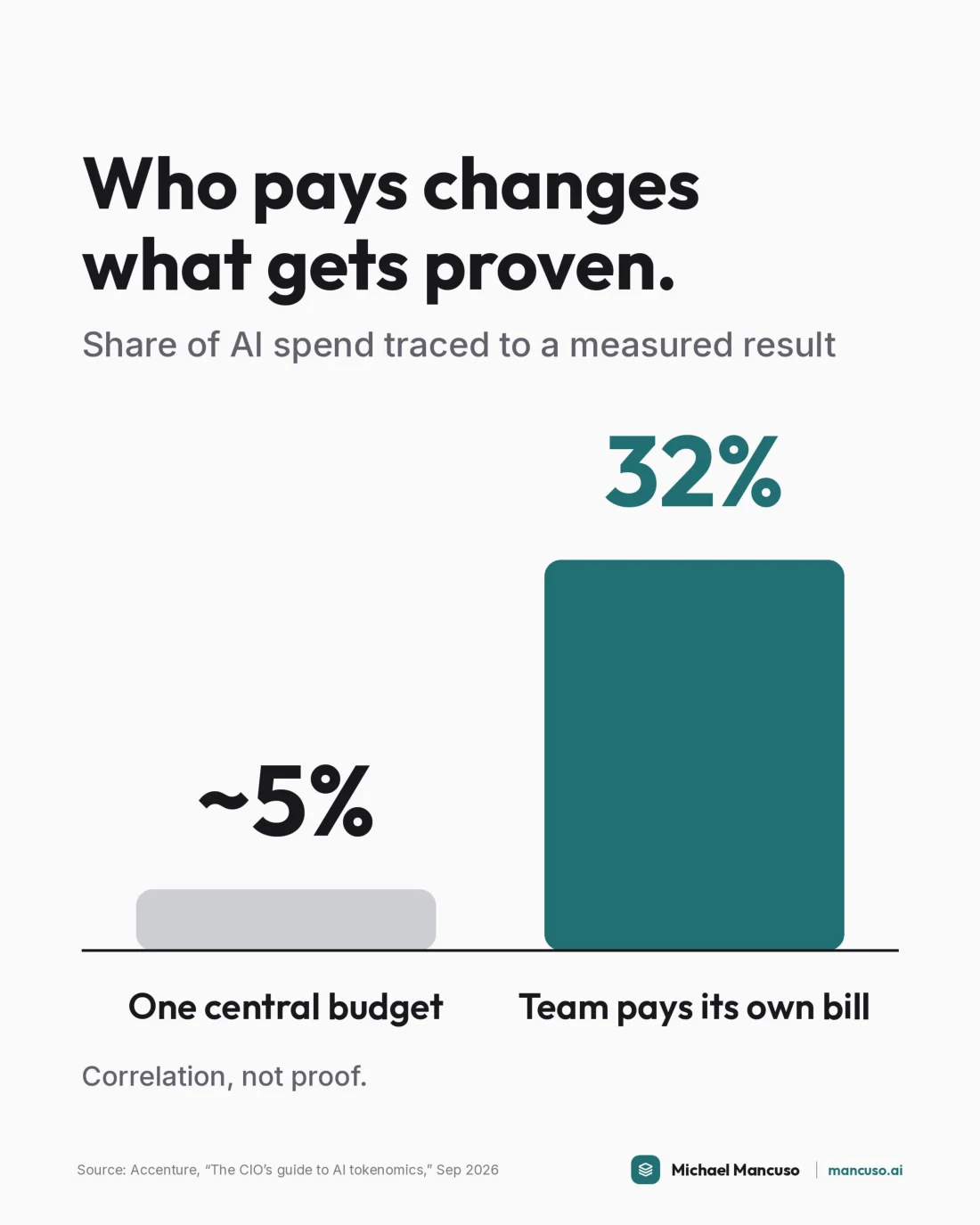
To the team using it, AI feels free. So nobody writes down what it's supposed to produce.

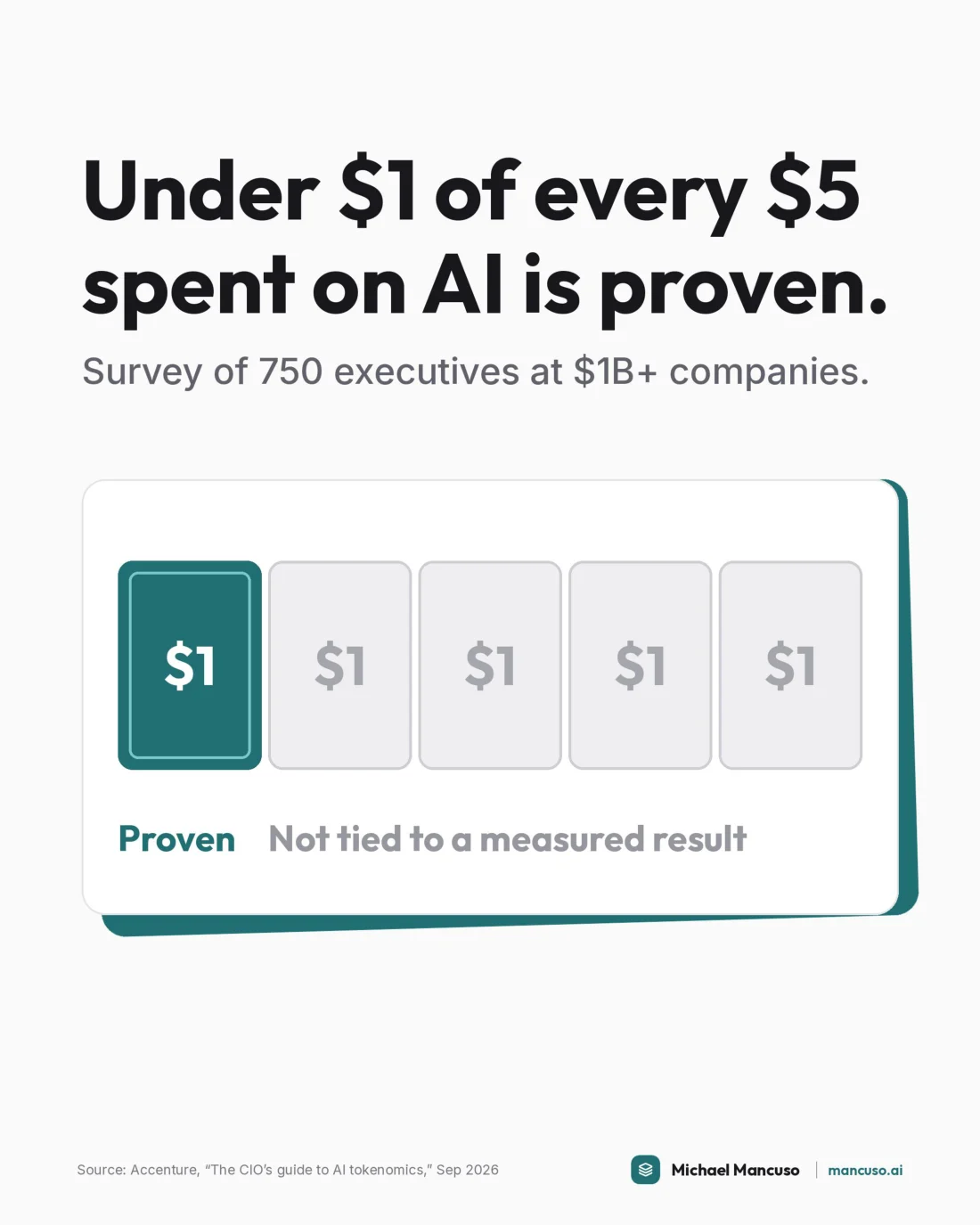
Accenture surveyed 750 executives at $1B+ companies in July.
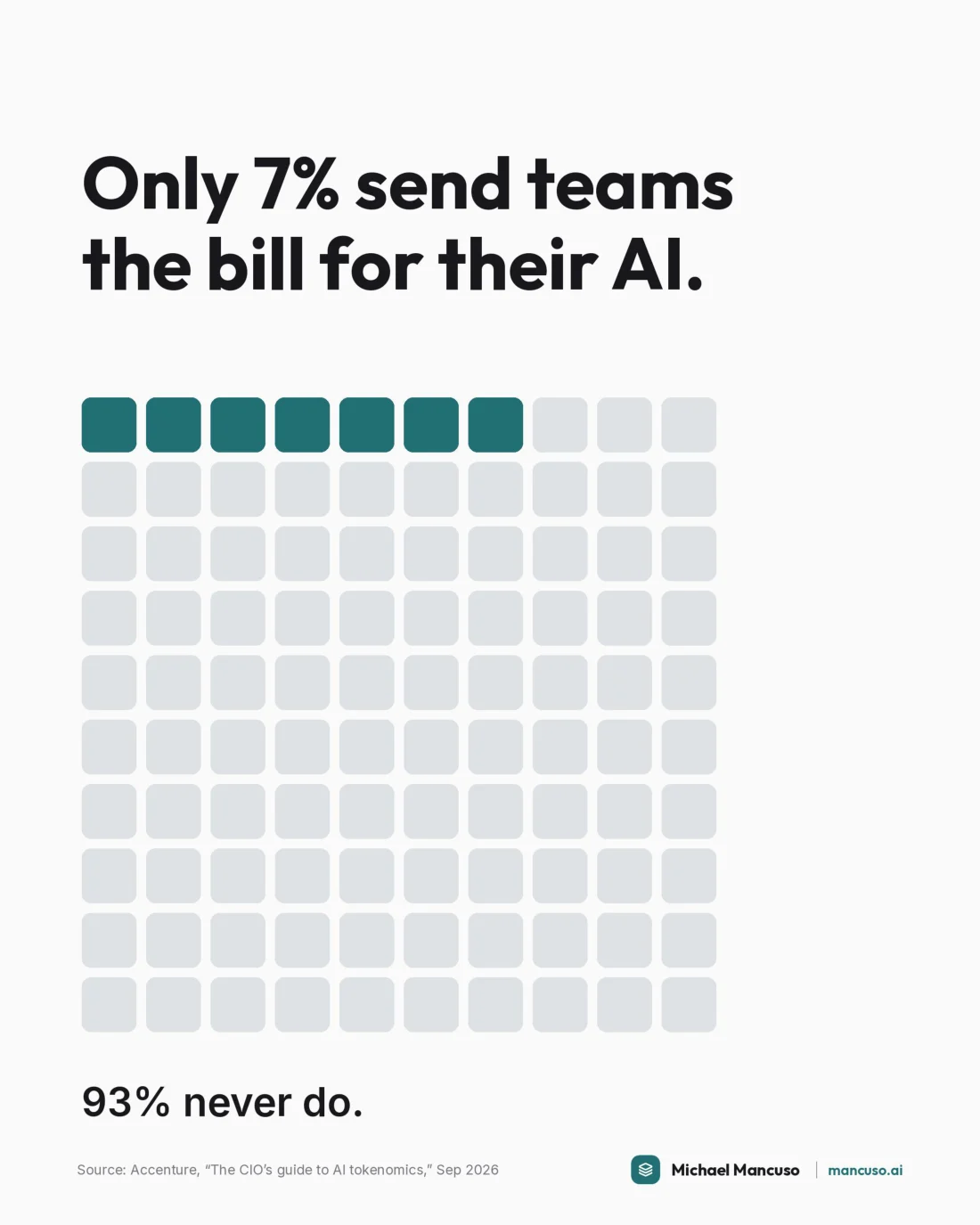
Under $1 of every $5 they spend on AI traces to a measured financial result.

The fix needs no new budget and no finance team.
Before a team or an agent gets more AI, write two lines:

Owner: ___
Expected result: ___ by ___

That's how I design AI work. A name and a number, before the work starts.

Accenture puts it plainly: it "needs to exist before the spend, not while trying to justify it afterward."

In an AI-native organization, nothing gets AI until someone owns what it's for.

#AI #Leadership

Same AI Model, 2% Explained to 70%: The Microscope Changed, page 1 of 7
Same AI Model, 2% Explained to 70%: The Microscope Changed, page 2 of 7
Same AI Model, 2% Explained to 70%: The Microscope Changed, page 3 of 7
Same AI Model, 2% Explained to 70%: The Microscope Changed, page 4 of 7
Same AI Model, 2% Explained to 70%: The Microscope Changed, page 5 of 7
Same AI Model, 2% Explained to 70%: The Microscope Changed, page 6 of 7
Same AI Model, 2% Explained to 70%: The Microscope Changed, page 7 of 7
1 / 7

Same AI Model, 2% Explained to 70%: The Microscope Changed

Every time you call a system a black box, you decide to stop looking at it.

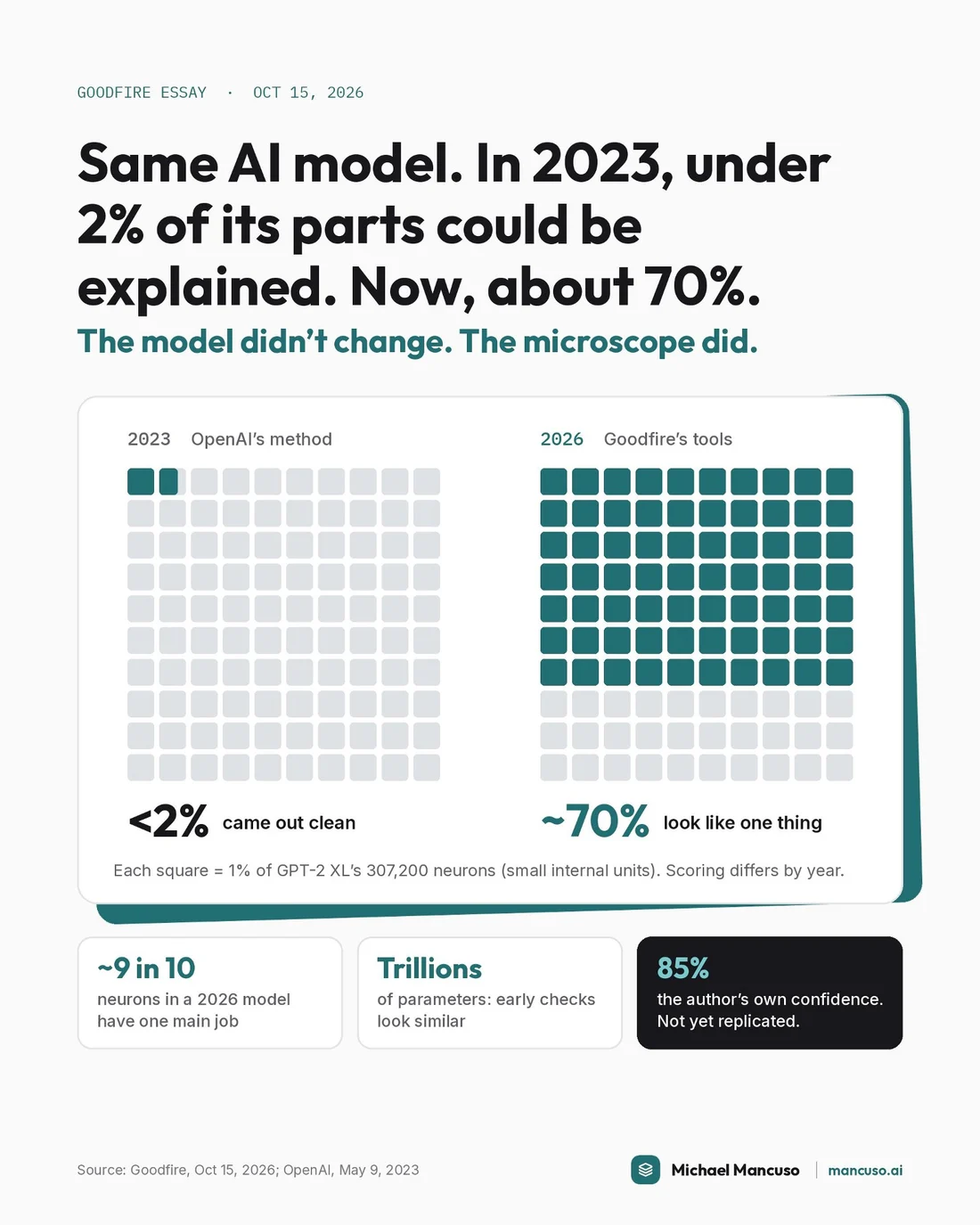
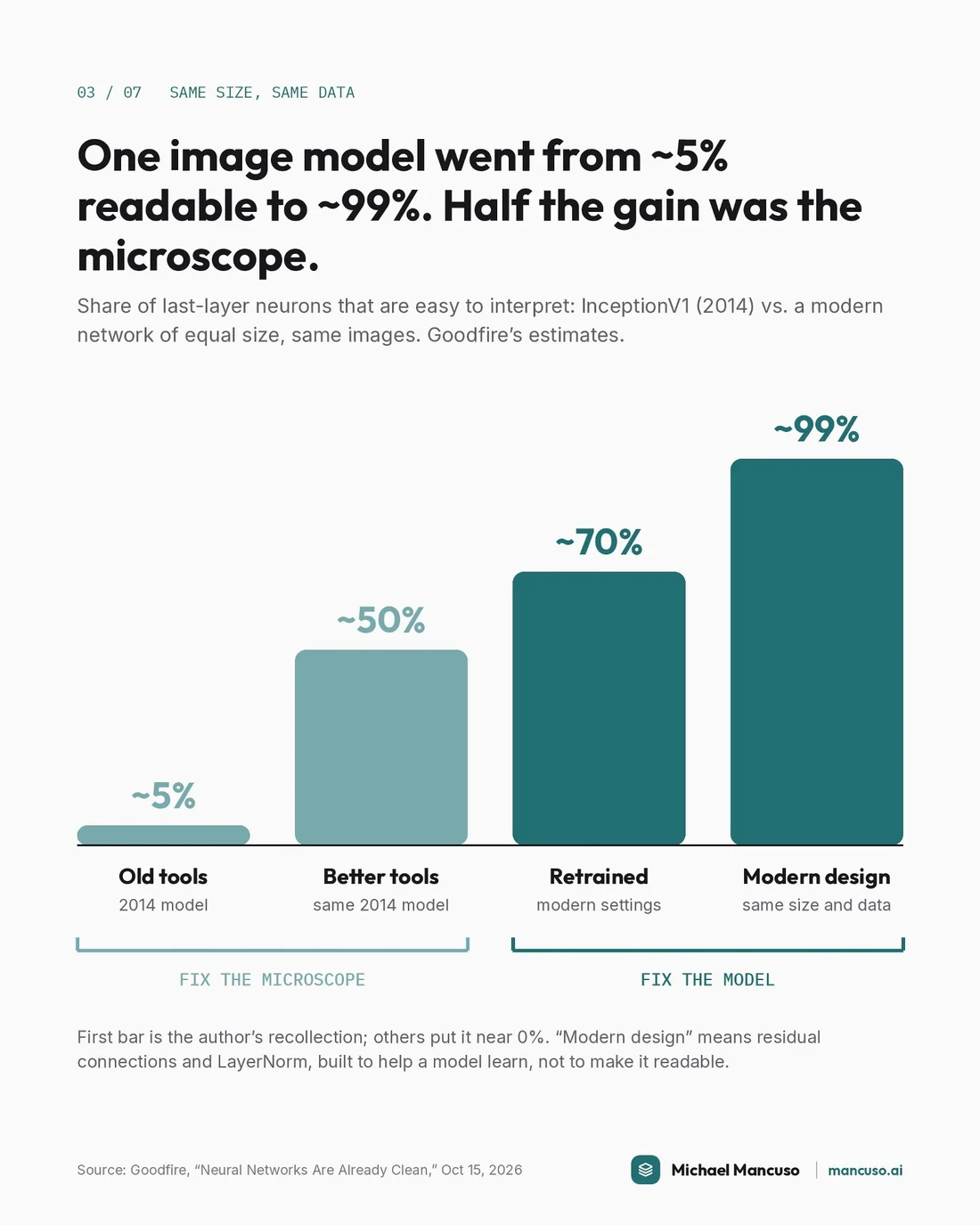
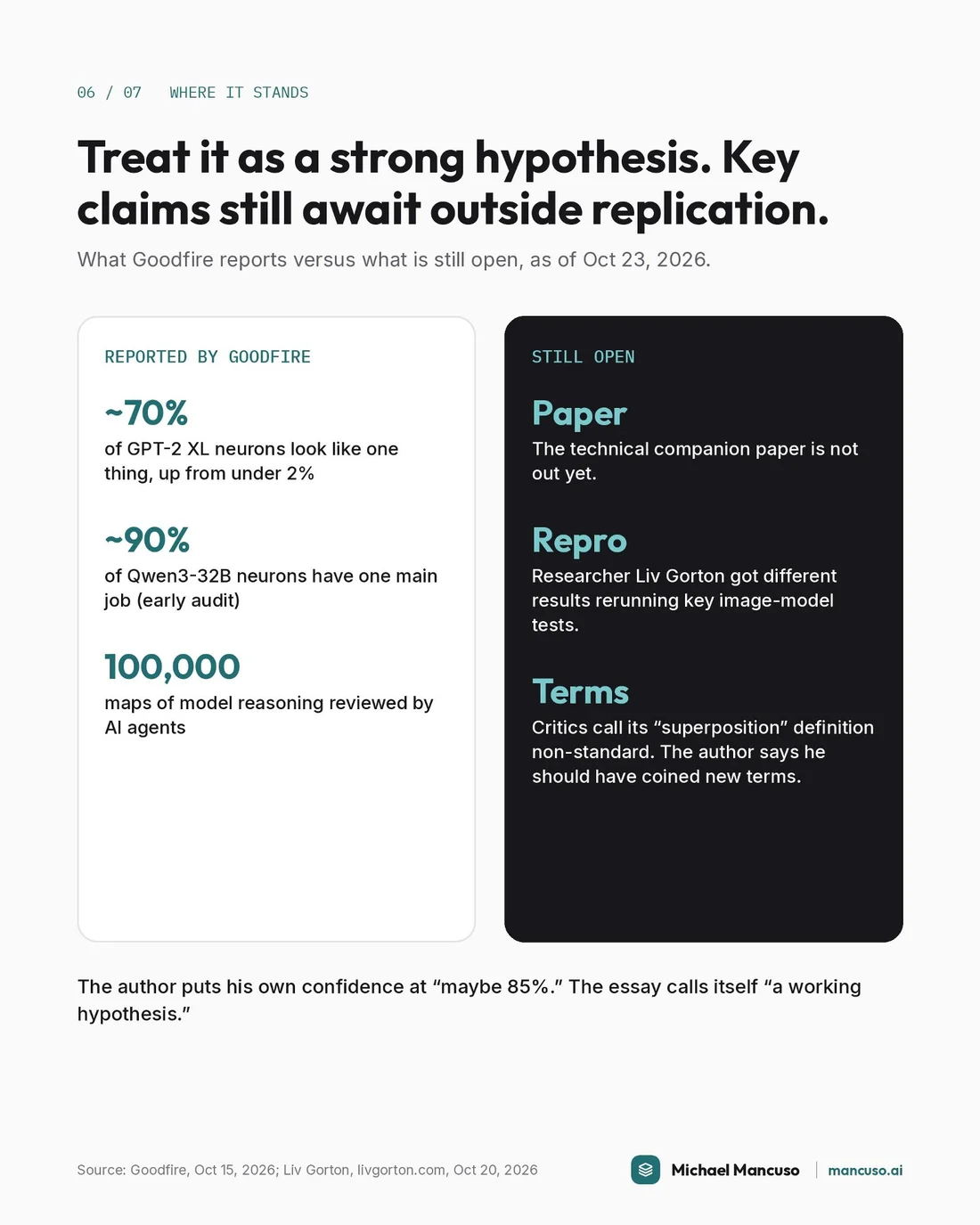
In 2023, an OpenAI project could explain fewer than 2% of the neurons in one AI model.
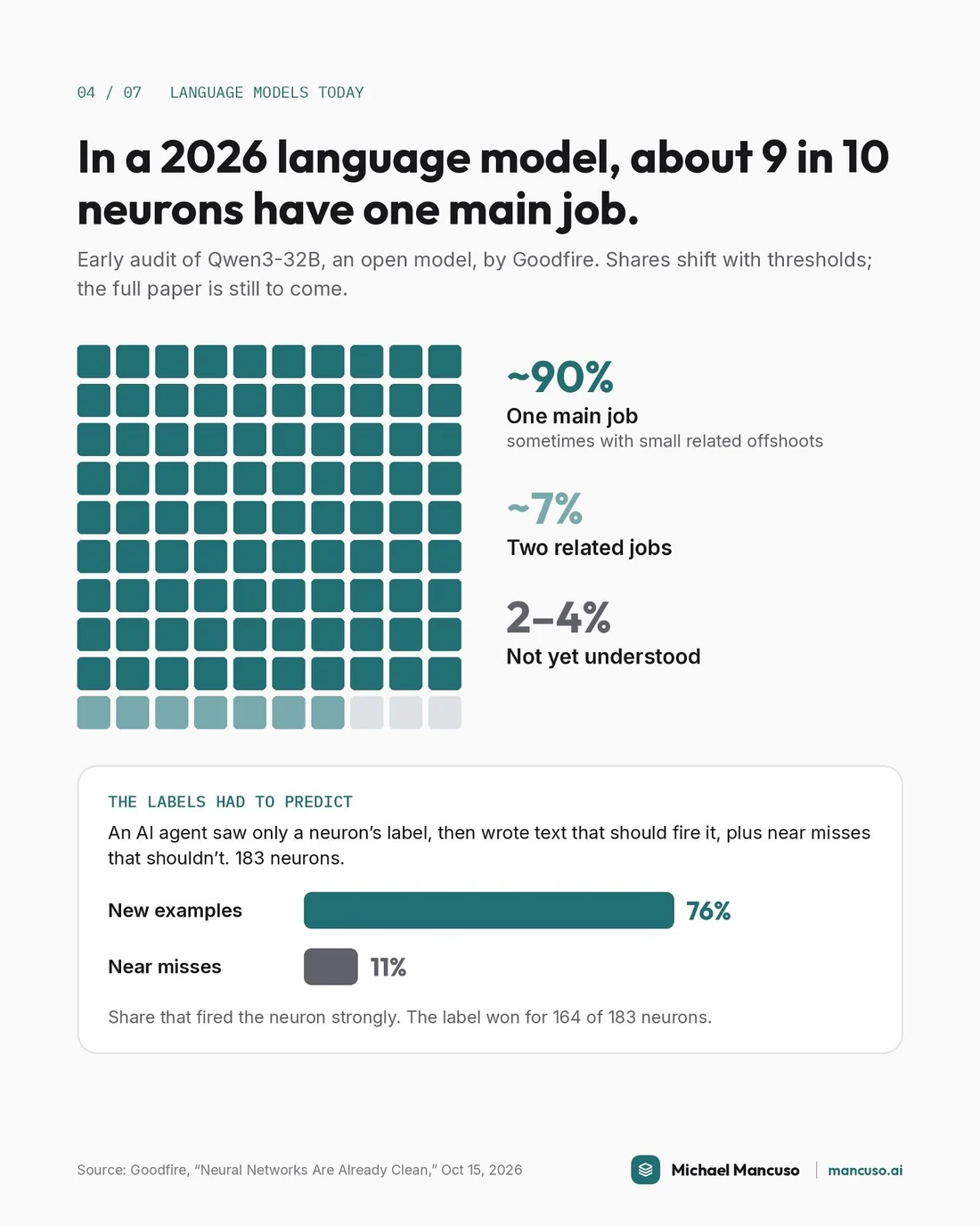
This month, the researcher who started it says better tools read about 70% of them as doing one thing.
Same neurons. Different microscope.

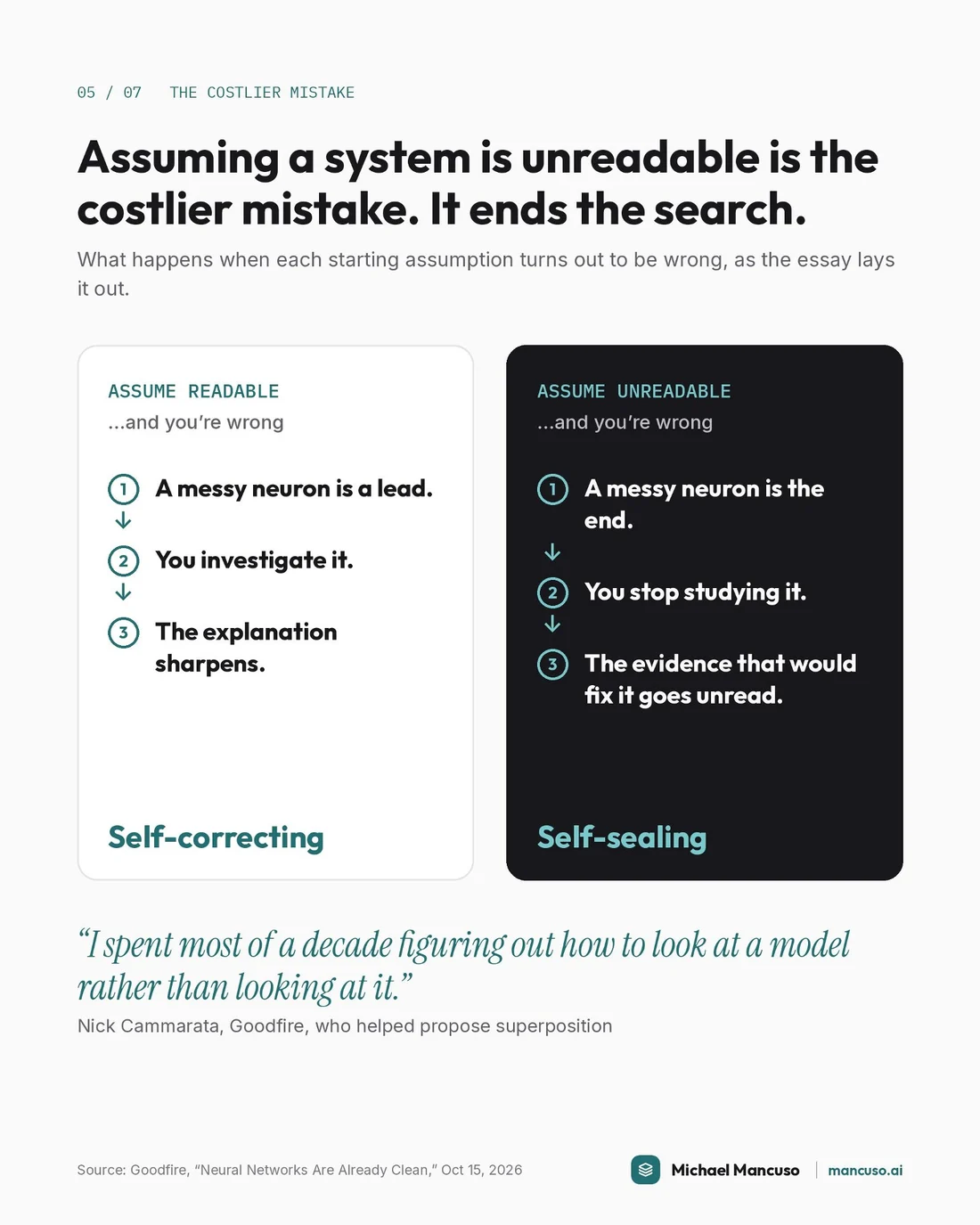
His sharper point is about assumptions.
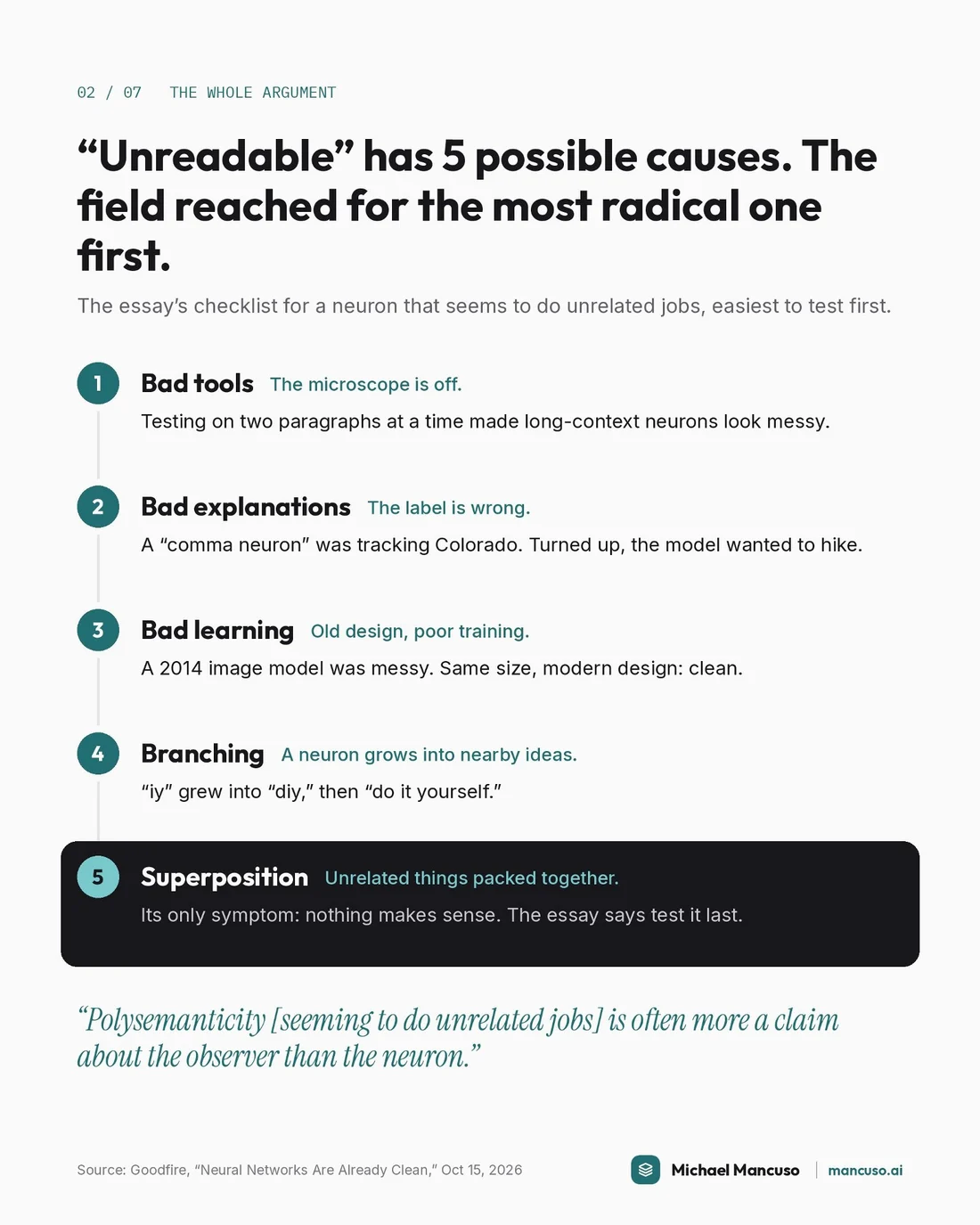
Assume a system is readable and you're wrong: a mess is a lead.
Assume it's unreadable and you're wrong: a mess is the end. You stop looking.

It's a working hypothesis. Critics dispute parts, and one researcher got different results rerunning his tests.
The asymmetry holds either way.

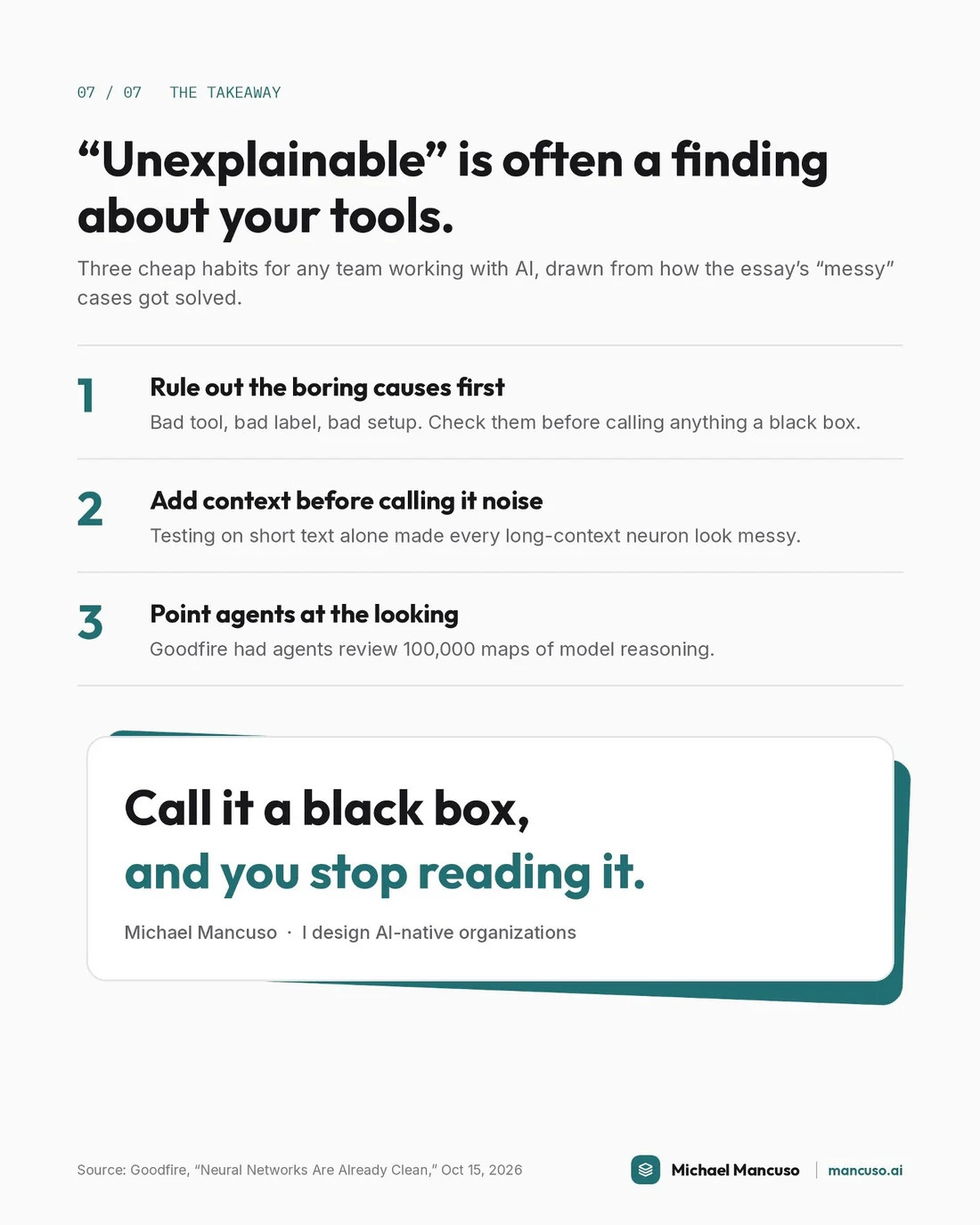
It's easy to treat AI at work the same way. "Nobody knows how it works," so nobody checks.

AI-native organizations treat "unexplainable" as a finding about their tools.

#AI #Interpretability

The Code Under 7 in 10 Websites Had a Takeover Flaw, page 1 of 7
The Code Under 7 in 10 Websites Had a Takeover Flaw, page 2 of 7
The Code Under 7 in 10 Websites Had a Takeover Flaw, page 3 of 7
The Code Under 7 in 10 Websites Had a Takeover Flaw, page 4 of 7
The Code Under 7 in 10 Websites Had a Takeover Flaw, page 5 of 7
The Code Under 7 in 10 Websites Had a Takeover Flaw, page 6 of 7
The Code Under 7 in 10 Websites Had a Takeover Flaw, page 7 of 7
1 / 7

The Code Under 7 in 10 Websites Had a Takeover Flaw

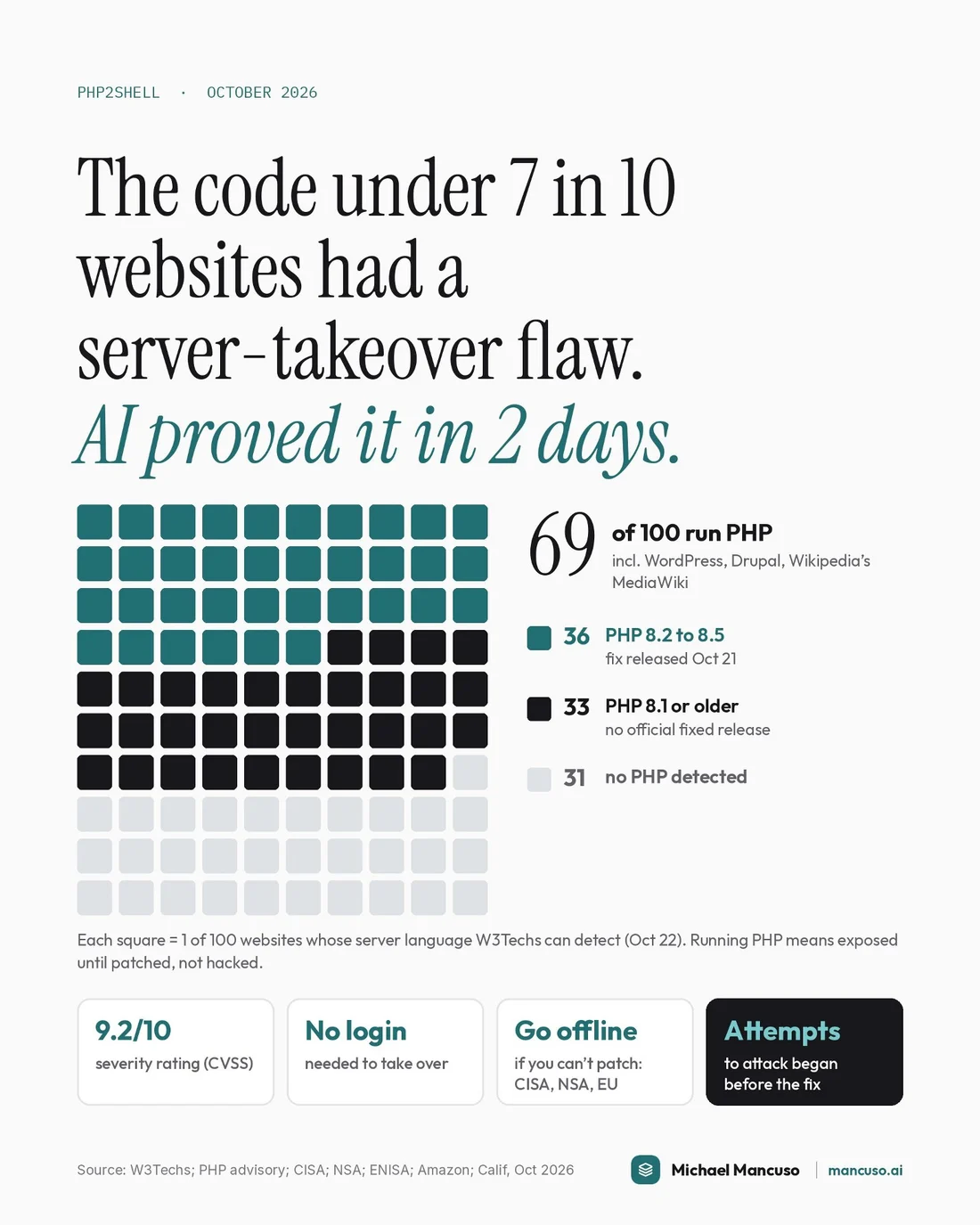
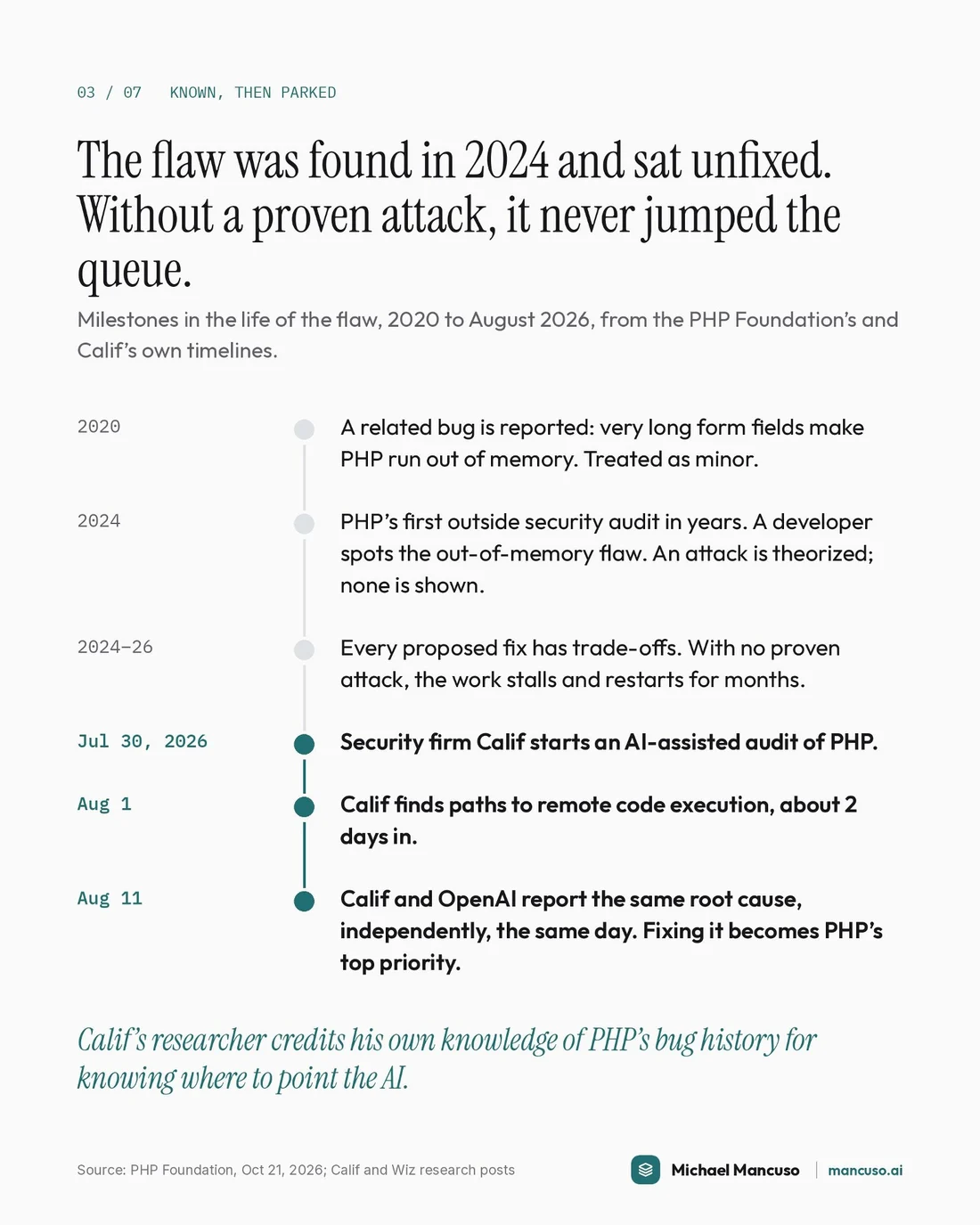
The code under 7 in 10 websites had a flaw that let strangers take over servers.
AI proved it in 2 days.

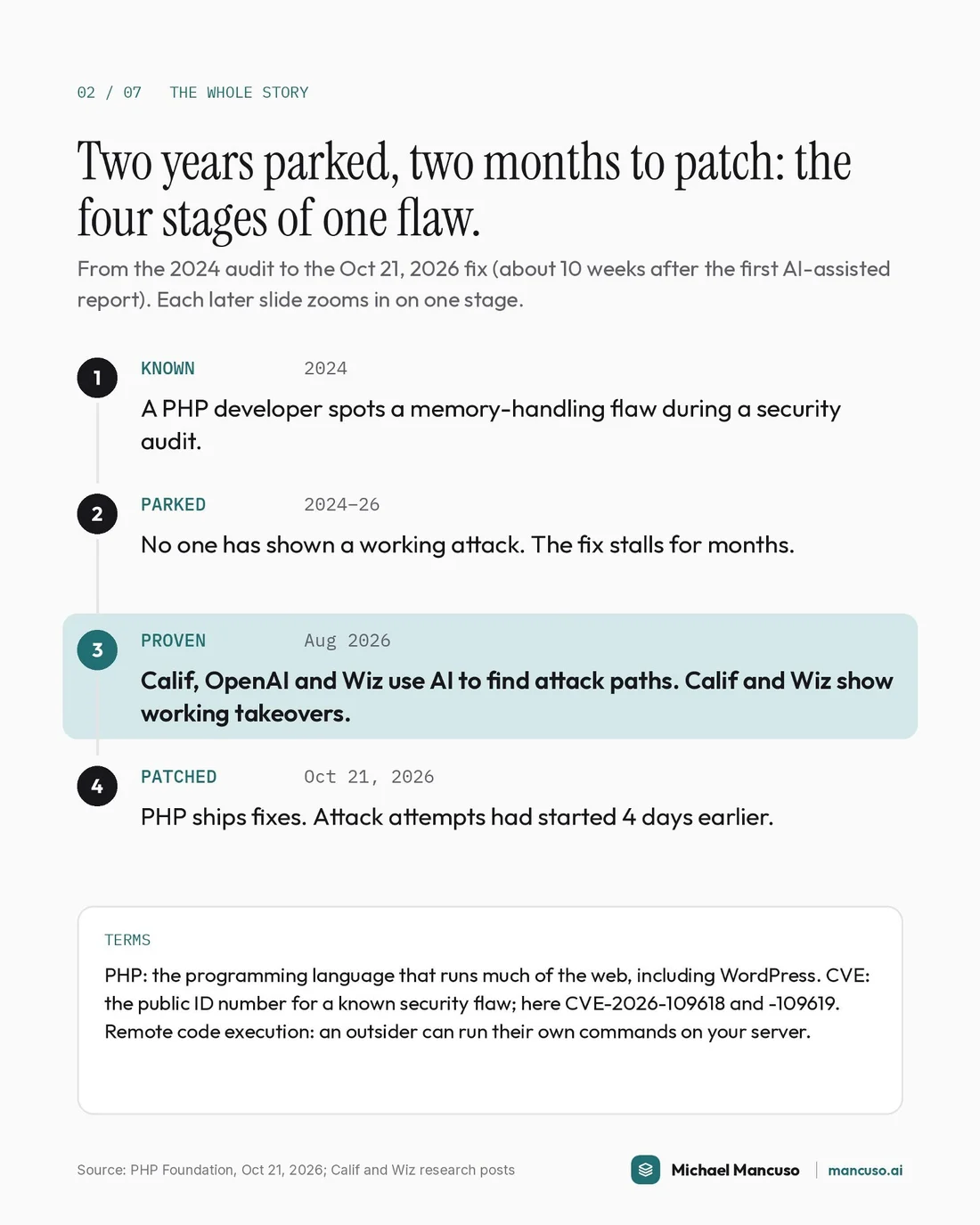
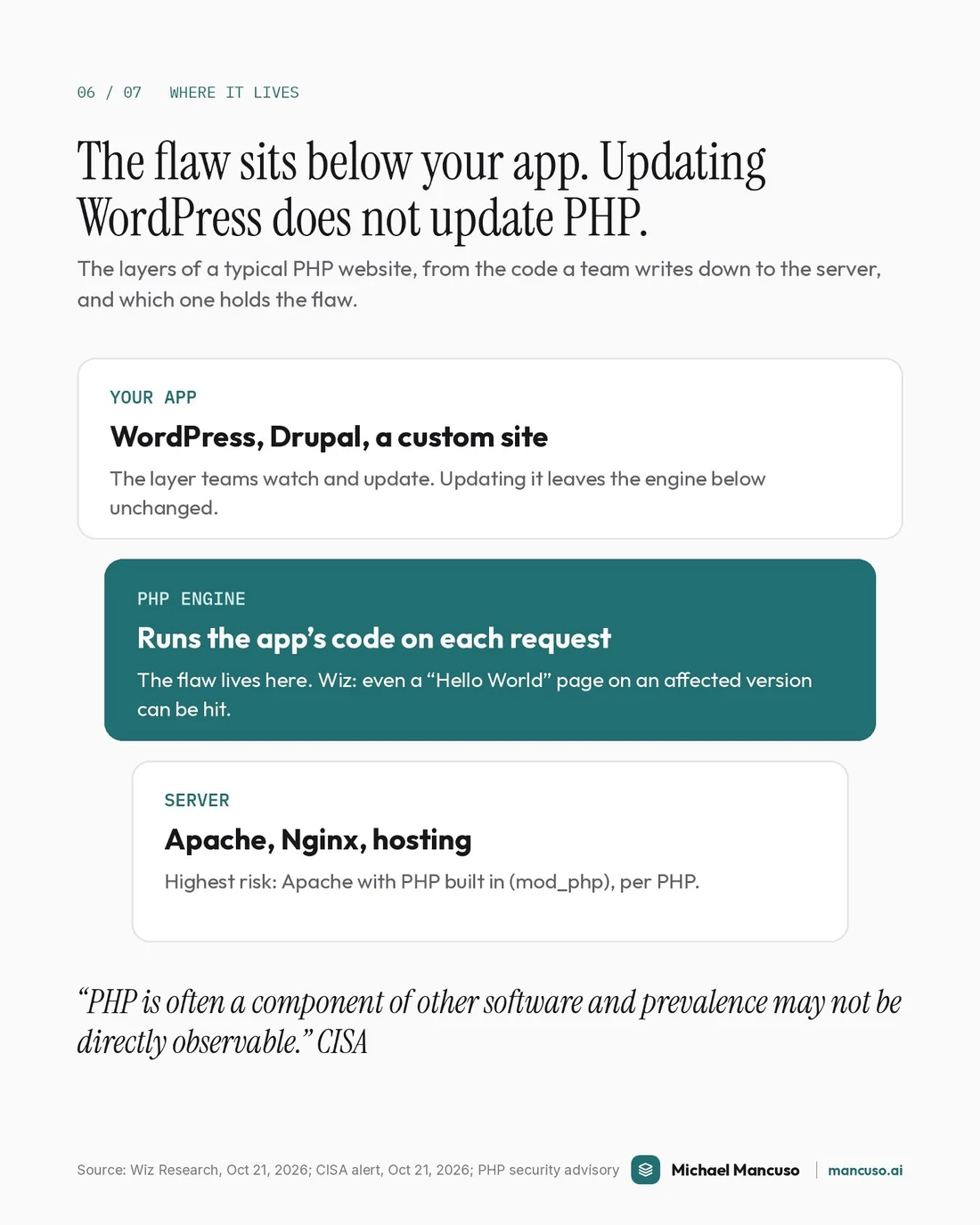
The code is PHP. It runs 69% of websites whose server language can be detected, including WordPress. The flaw was spotted in 2024. No one had shown a working attack, so it waited.

That's a sensible habit. Teams rank work by proof. "Theoretical" sinks to the bottom.

This summer, researchers at Calif and Wiz used AI to build working attacks.

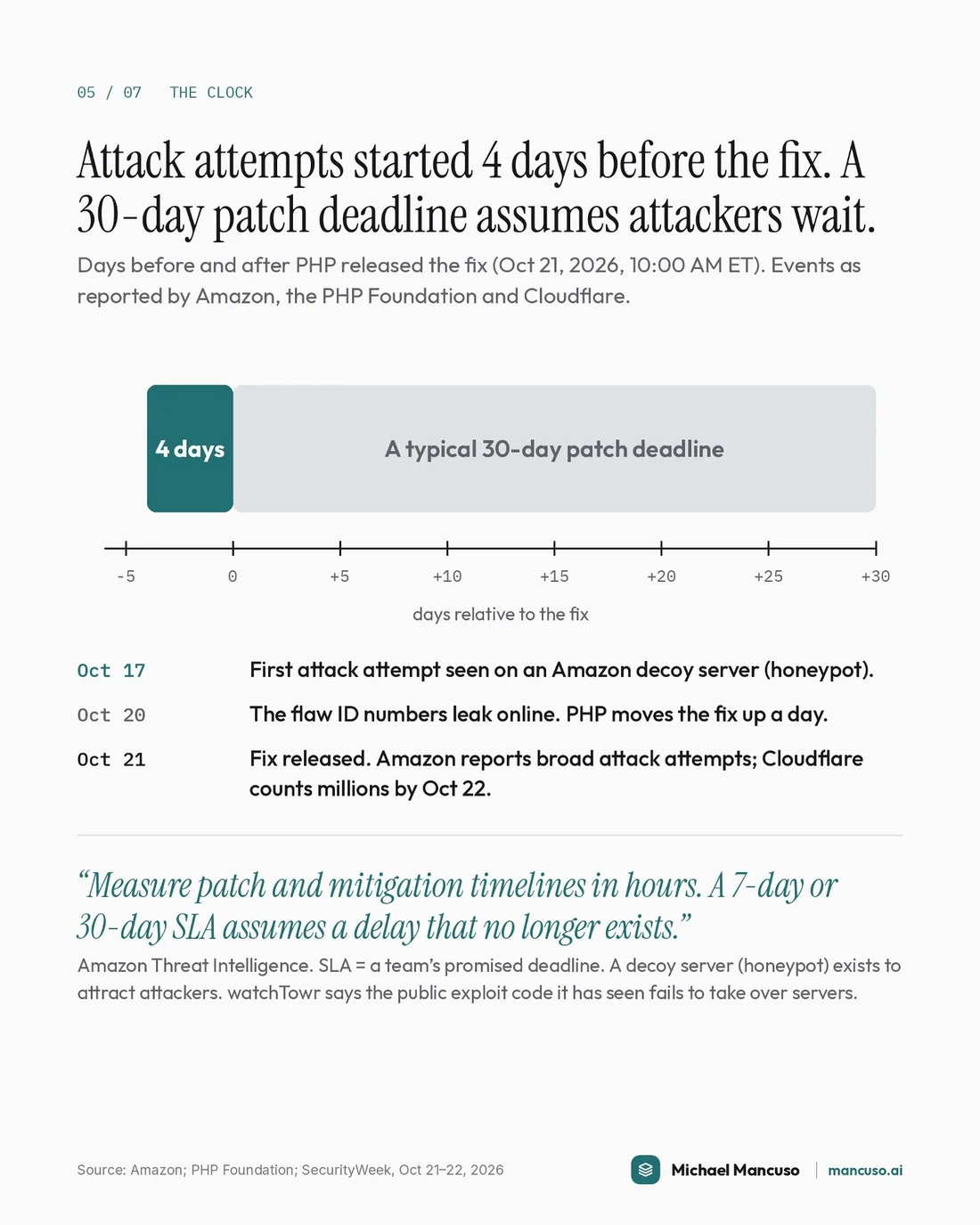
The first attack attempt hit an Amazon decoy server on Oct 17. PHP shipped the fix on Oct 21.

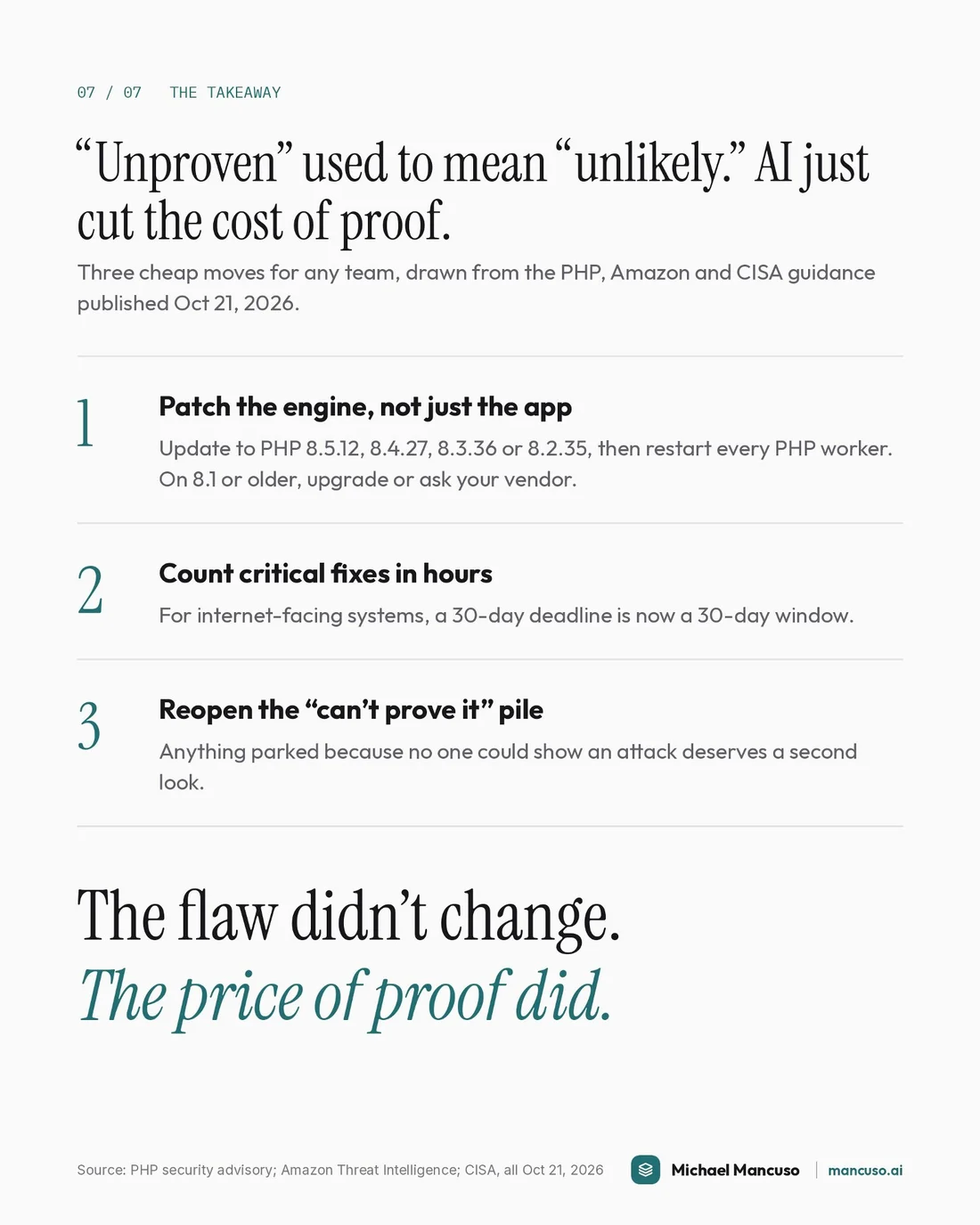
The flaw didn't change. The price of proof did.

Every backlog has a pile marked "can't prove it." AI just repriced it.

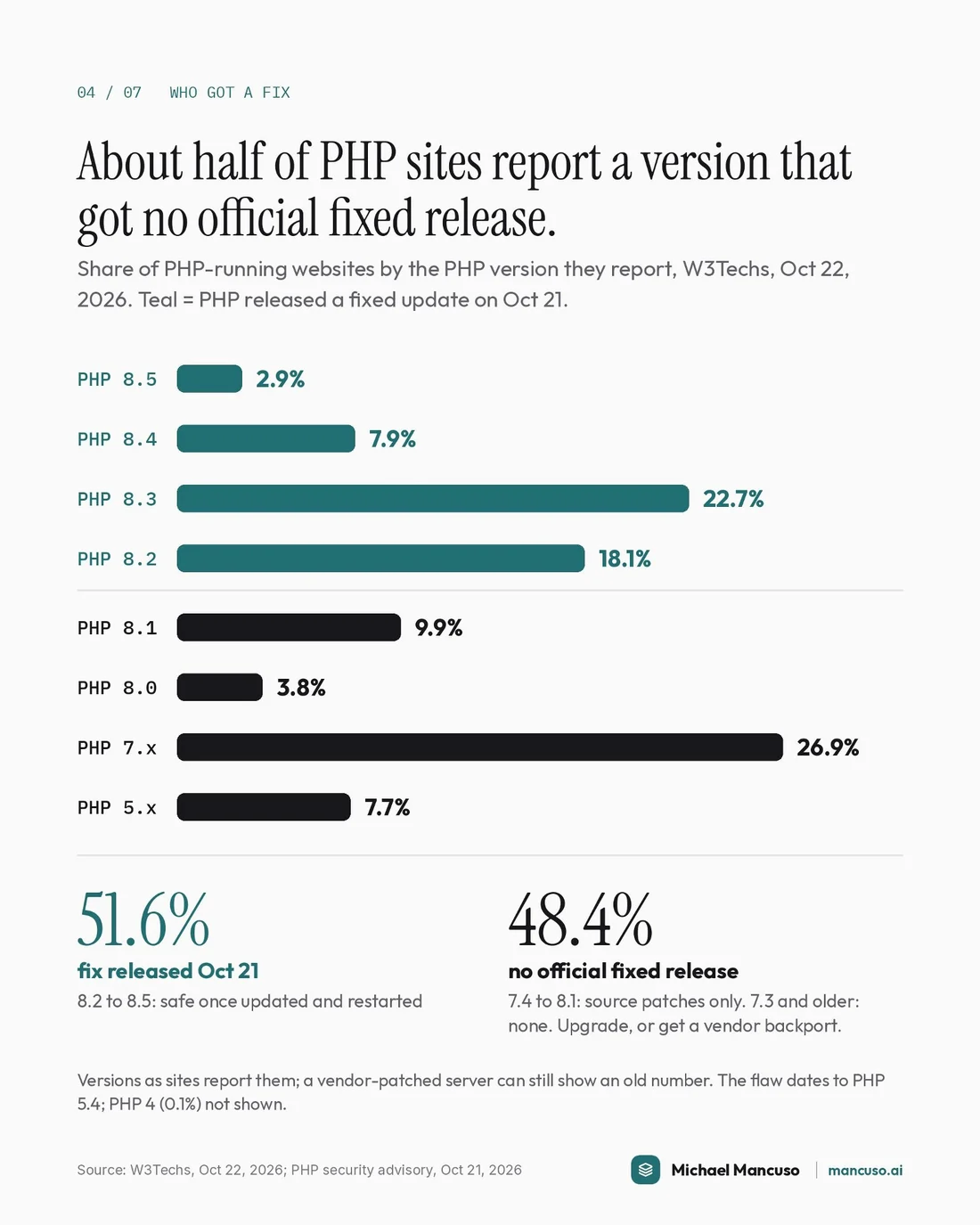
Update PHP itself, not just the app on top. Then reopen whatever you parked as unproven.

In an AI-native org, "unproven" is a timestamp, not a verdict.

#AI #Cybersecurity

Same Answer, 725× Cheaper. Same Bill., page 1 of 7
Same Answer, 725× Cheaper. Same Bill., page 2 of 7
Same Answer, 725× Cheaper. Same Bill., page 3 of 7
Same Answer, 725× Cheaper. Same Bill., page 4 of 7
Same Answer, 725× Cheaper. Same Bill., page 5 of 7
Same Answer, 725× Cheaper. Same Bill., page 6 of 7
Same Answer, 725× Cheaper. Same Bill., page 7 of 7
1 / 7

Same Answer, 725× Cheaper. Same Bill.

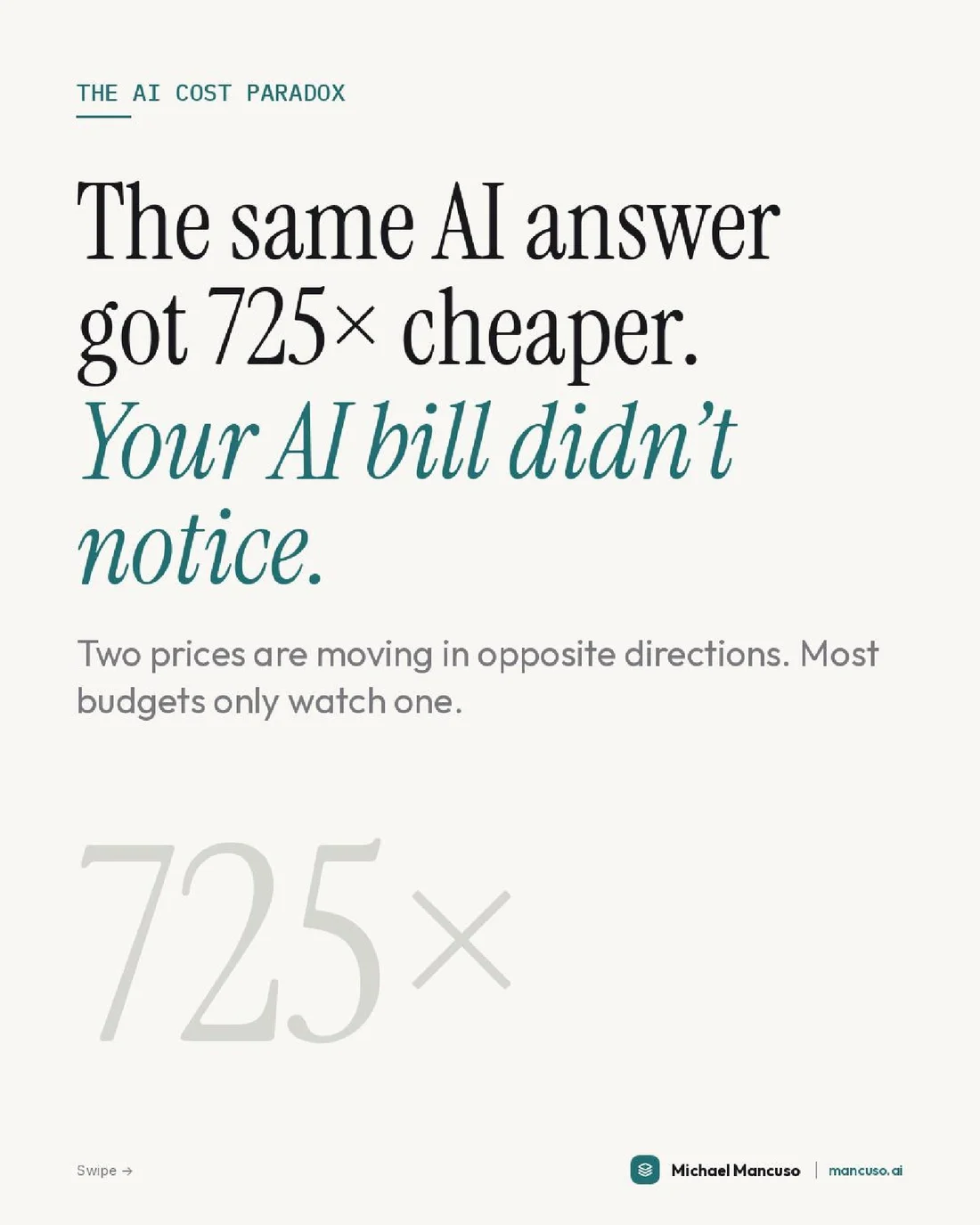
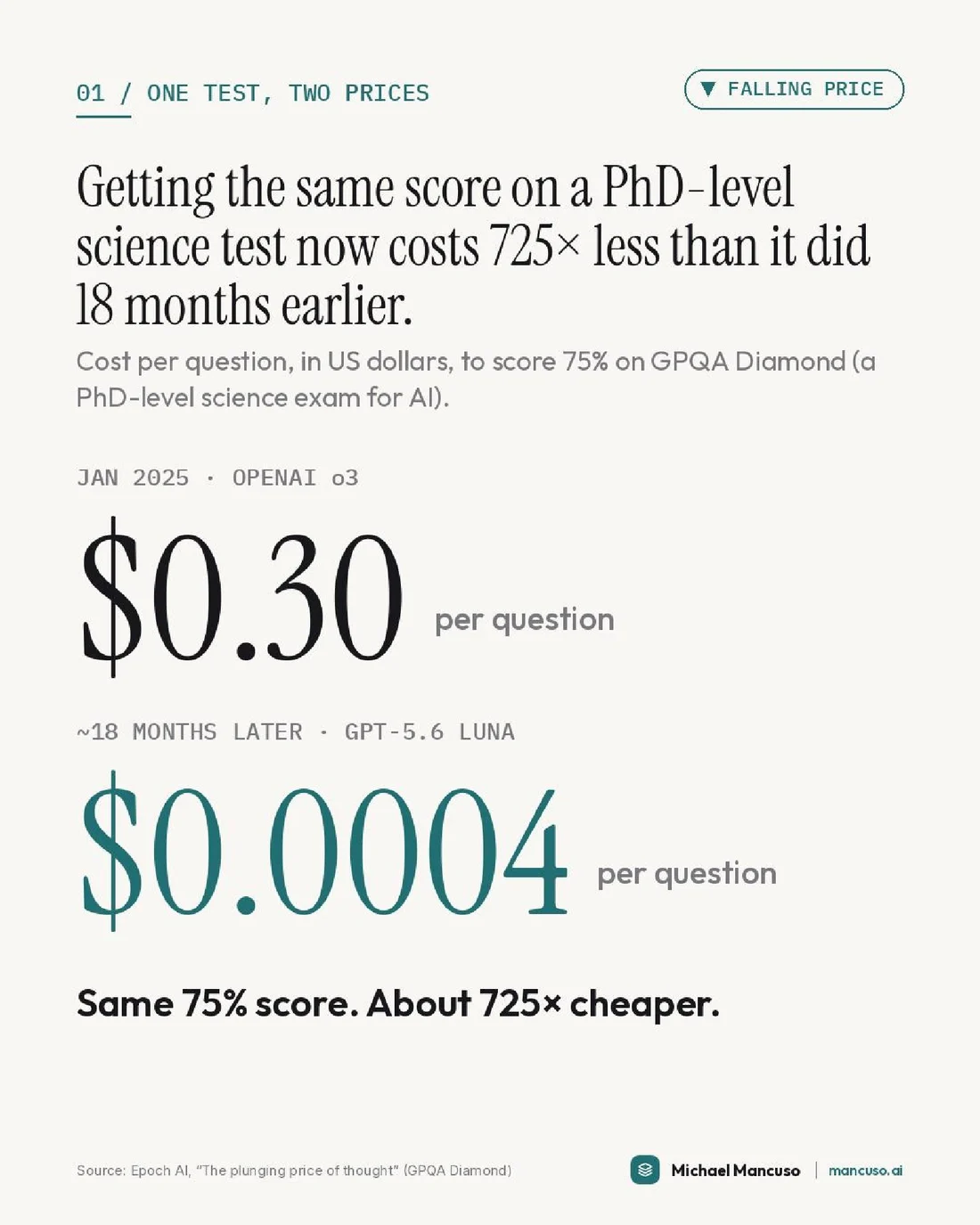
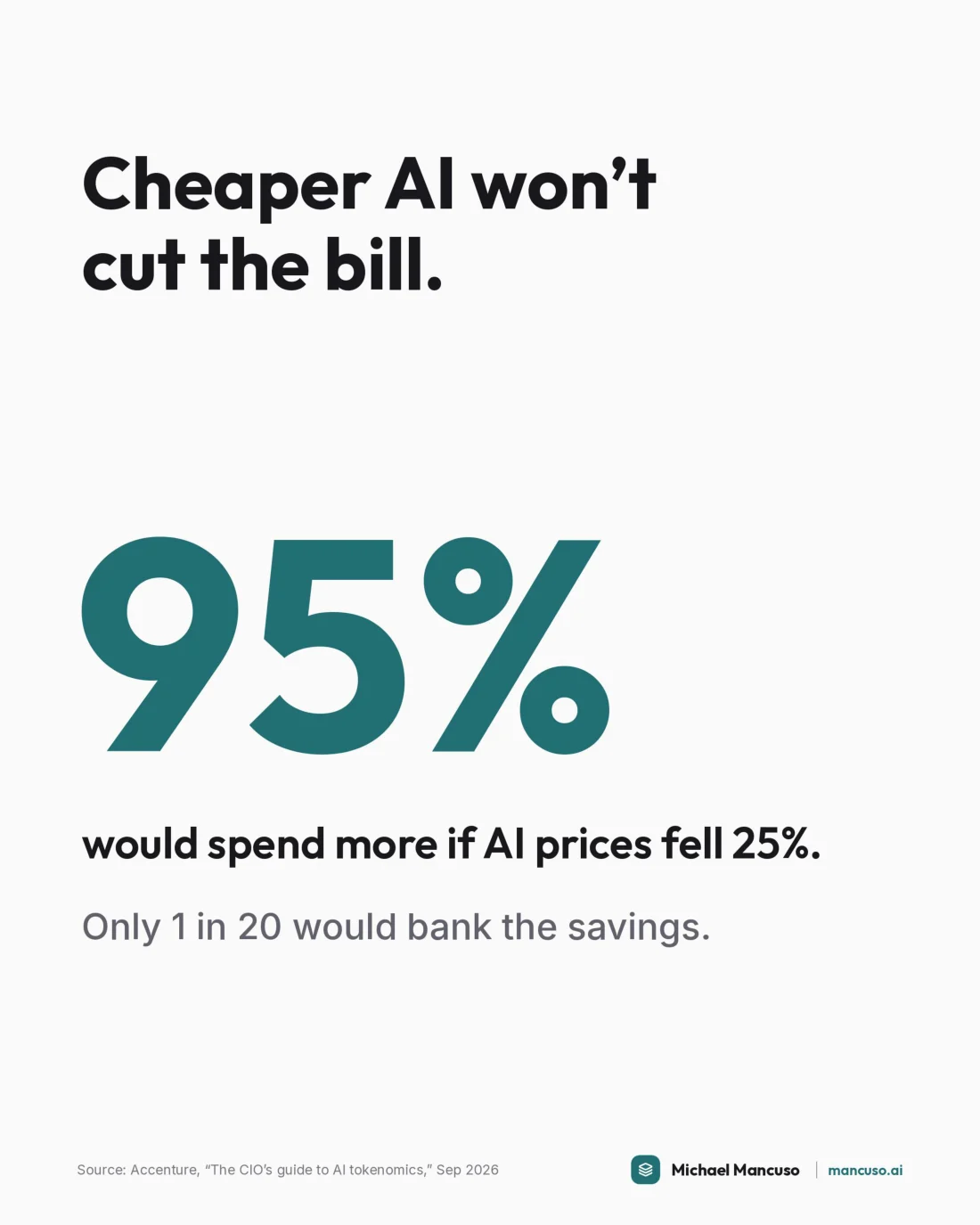
In January 2025, getting an AI to score 75% on a PhD-level science test cost about thirty cents a question. Eighteen months later, according to Epoch AI, you could get the same score for four hundredths of a cent. Roughly 725 times cheaper.

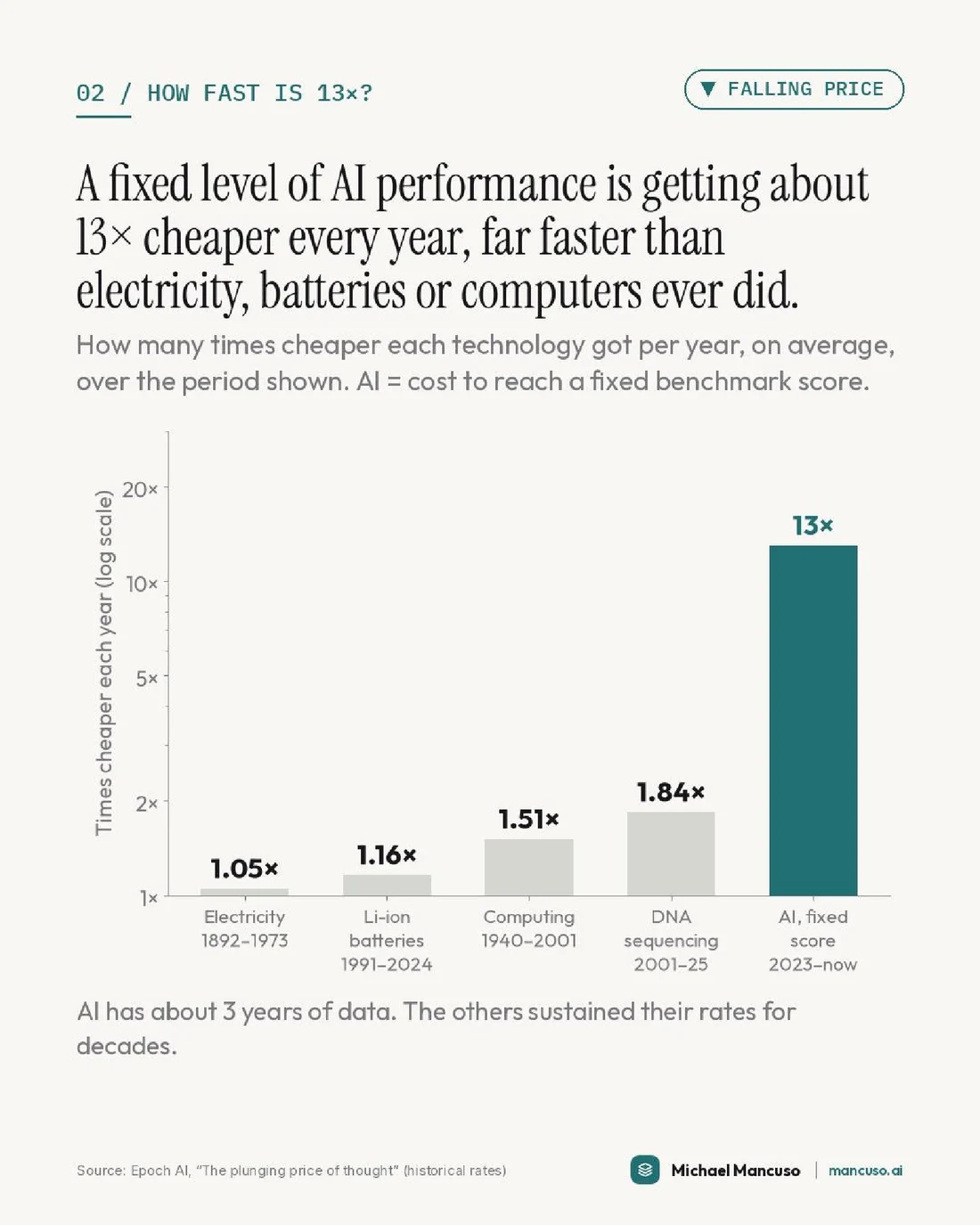
Electricity got cheaper at about 5% a year. Batteries, 16%. Computing, about 1.5 times a year for six decades. A fixed level of AI capability is getting about 13 times cheaper every year.

So why is nobody’s AI bill shrinking?

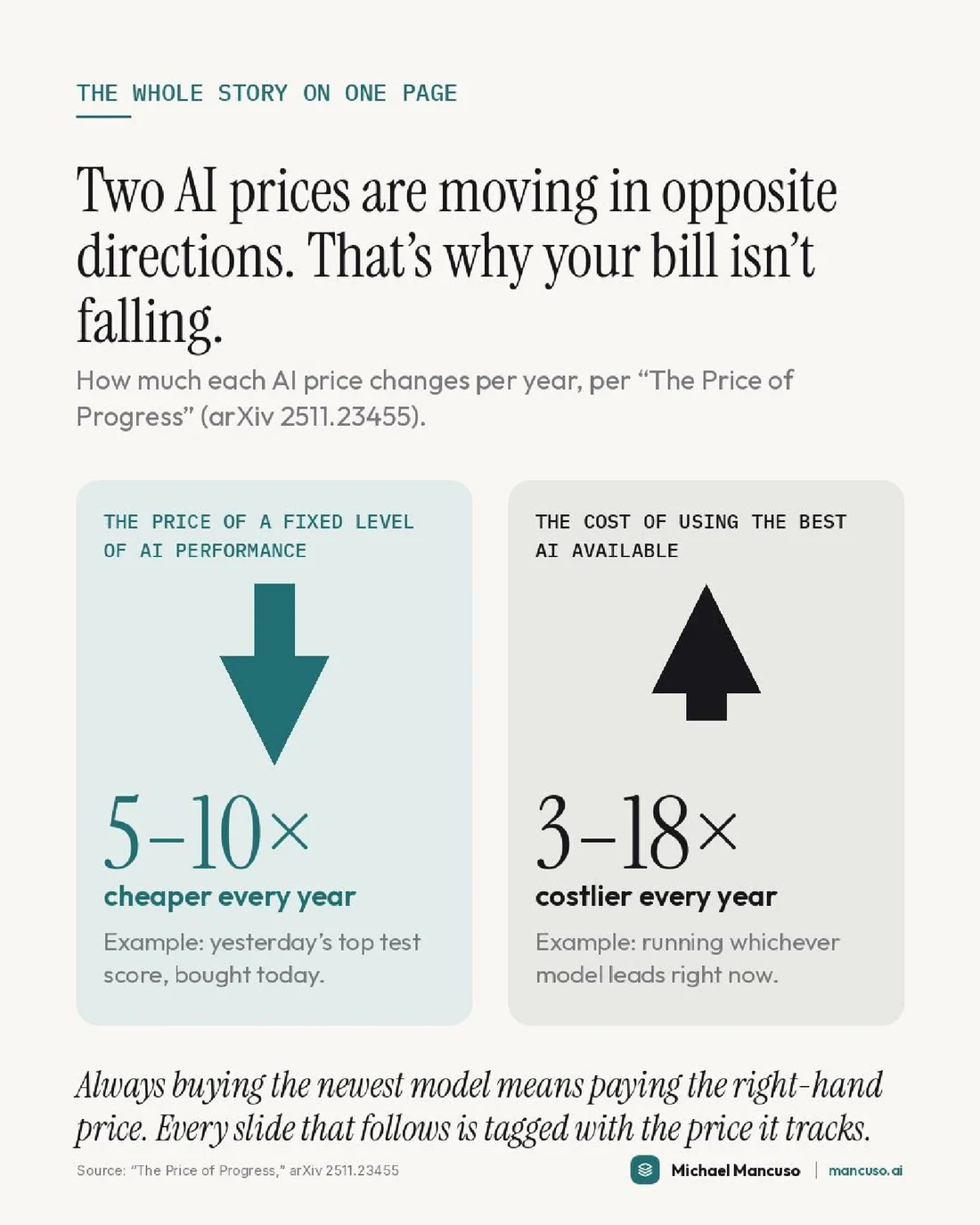
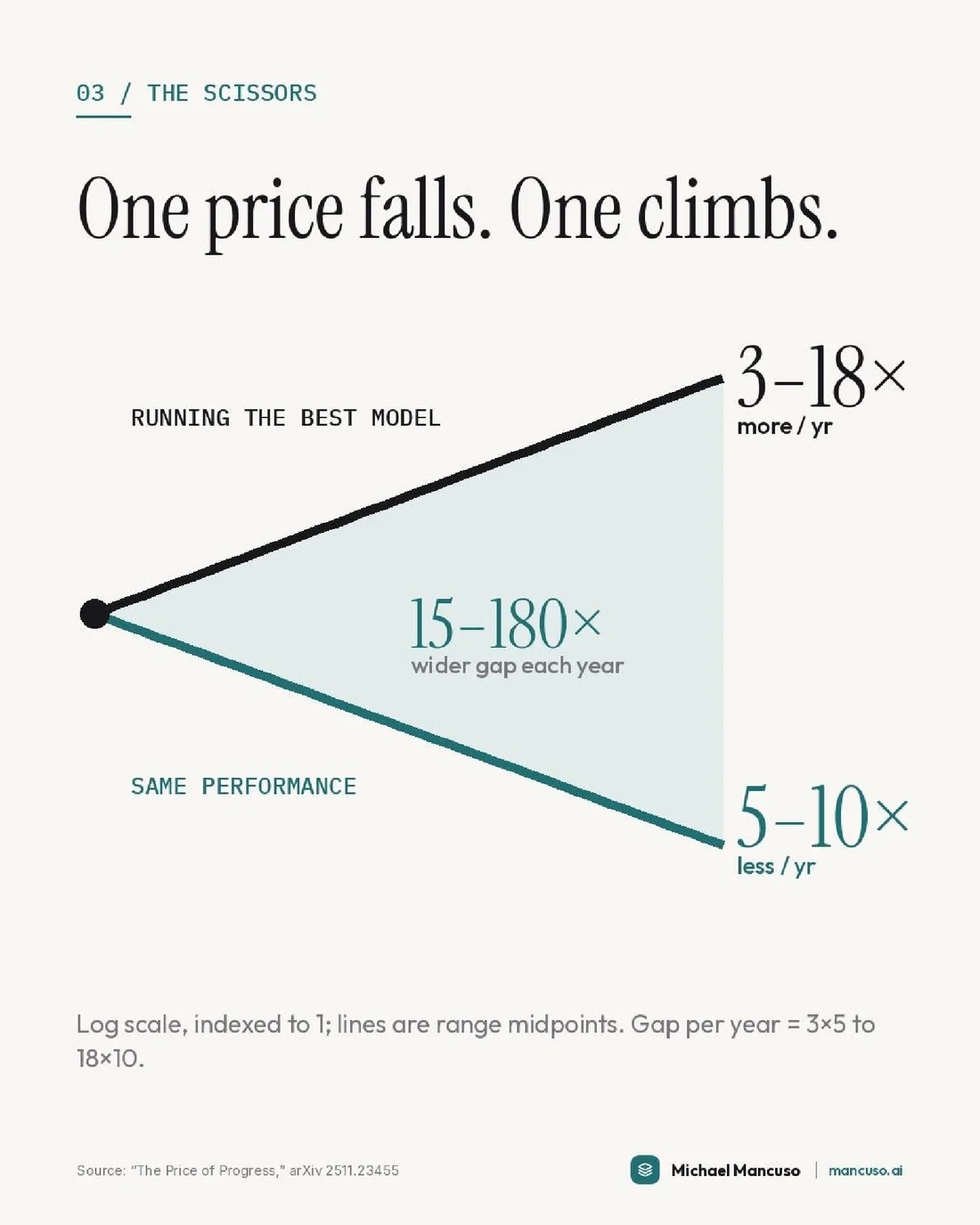
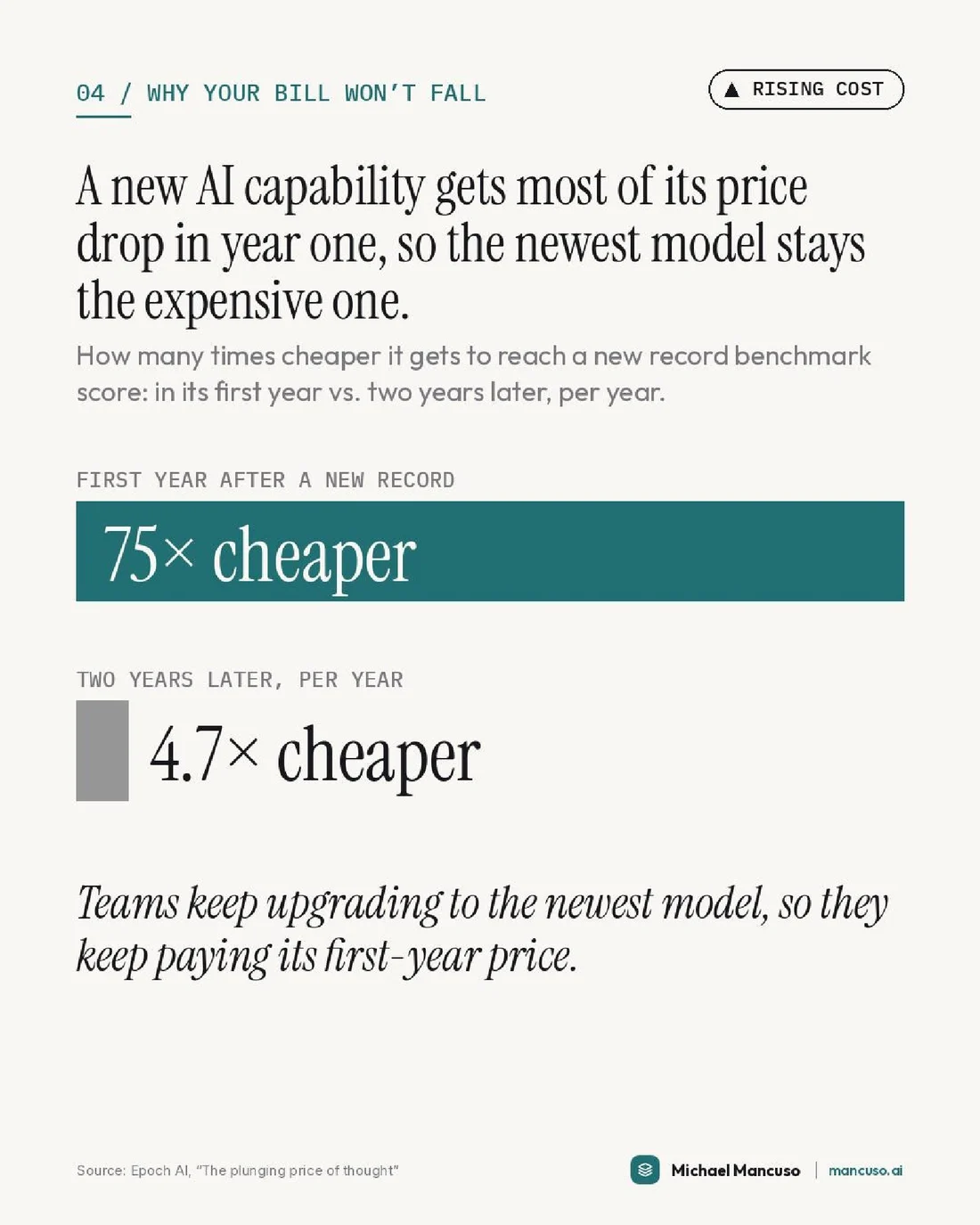
Because nobody buys a fixed level of capability. We buy the best one. And a separate study finds the cost of running the best available model has risen about 3 to 18 times a year, even as the price of yesterday’s performance falls 5 to 10 times.

It’s the same reason a new phone costs what it does, even though last year’s phone is now nearly free. The price of a thing falls. The price of status doesn’t.

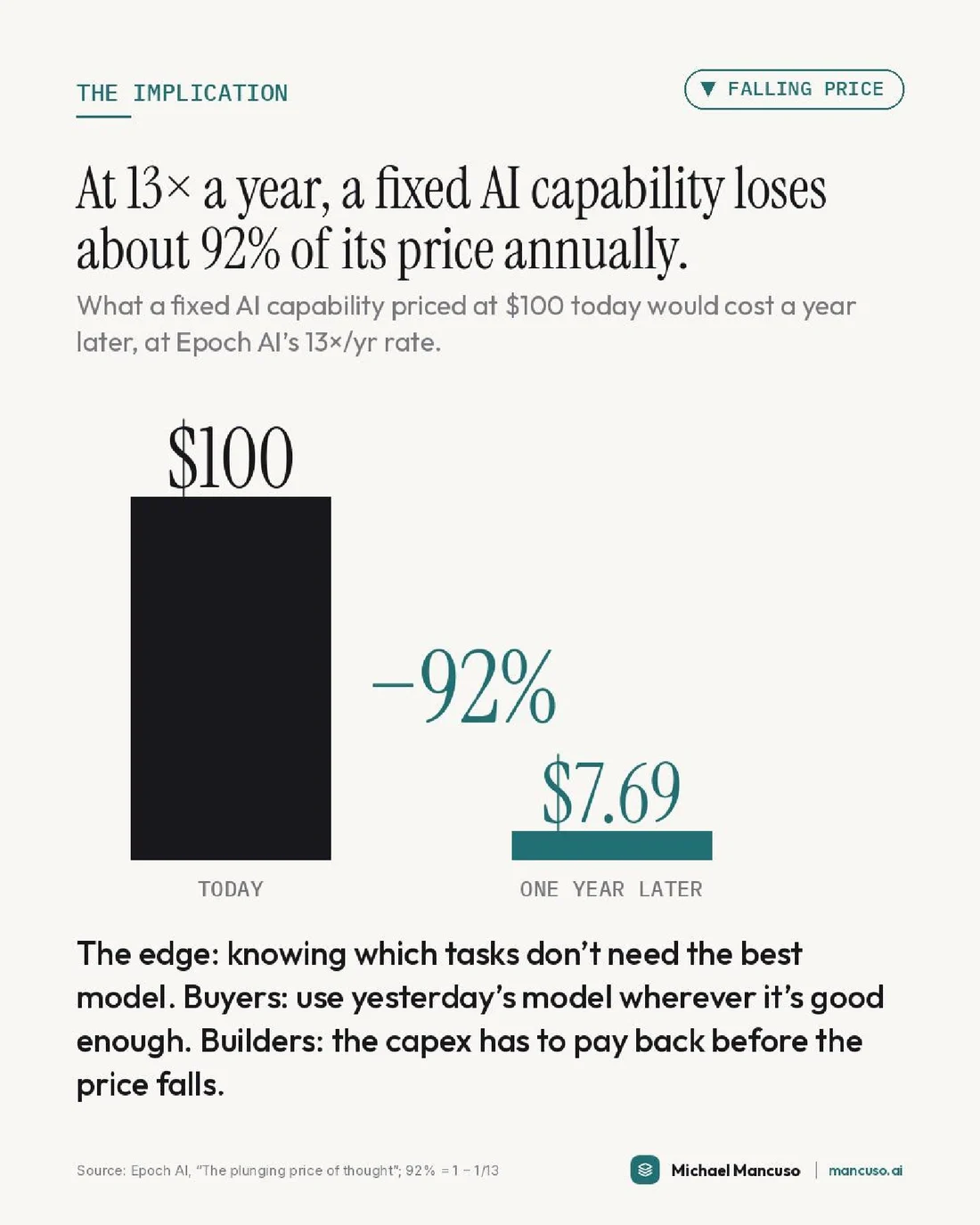
This is wonderful news for buyers who know which jobs don’t need the frontier. It’s harder news for builders. At 13 times a year, a product loses about 92% of its price annually. The capex has to pay back before the price does.

The real skill now is knowing when you don’t need the best model.

Jevons' Paradox Ate Jev, page 1 of 5
Jevons' Paradox Ate Jev, page 2 of 5
Jevons' Paradox Ate Jev, page 3 of 5
Jevons' Paradox Ate Jev, page 4 of 5
Jevons' Paradox Ate Jev, page 5 of 5
1 / 5

Jevons' Paradox Ate Jev

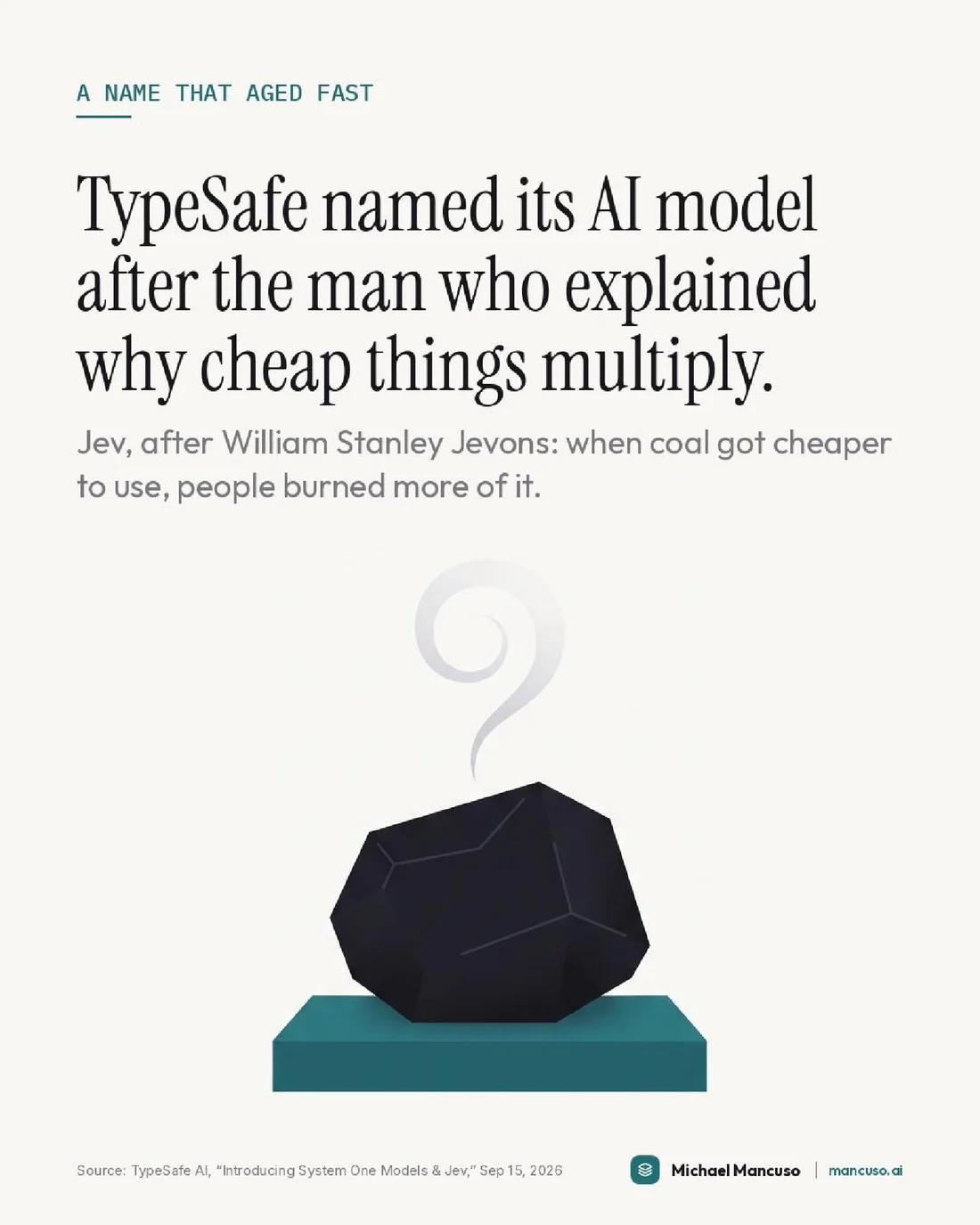
TypeSafe named its new AI model Jev, after William Stanley Jevons, the economist who noticed that when coal got cheaper to use, people burned more of it, not less. It was a clever name. It may also have been a prophecy.

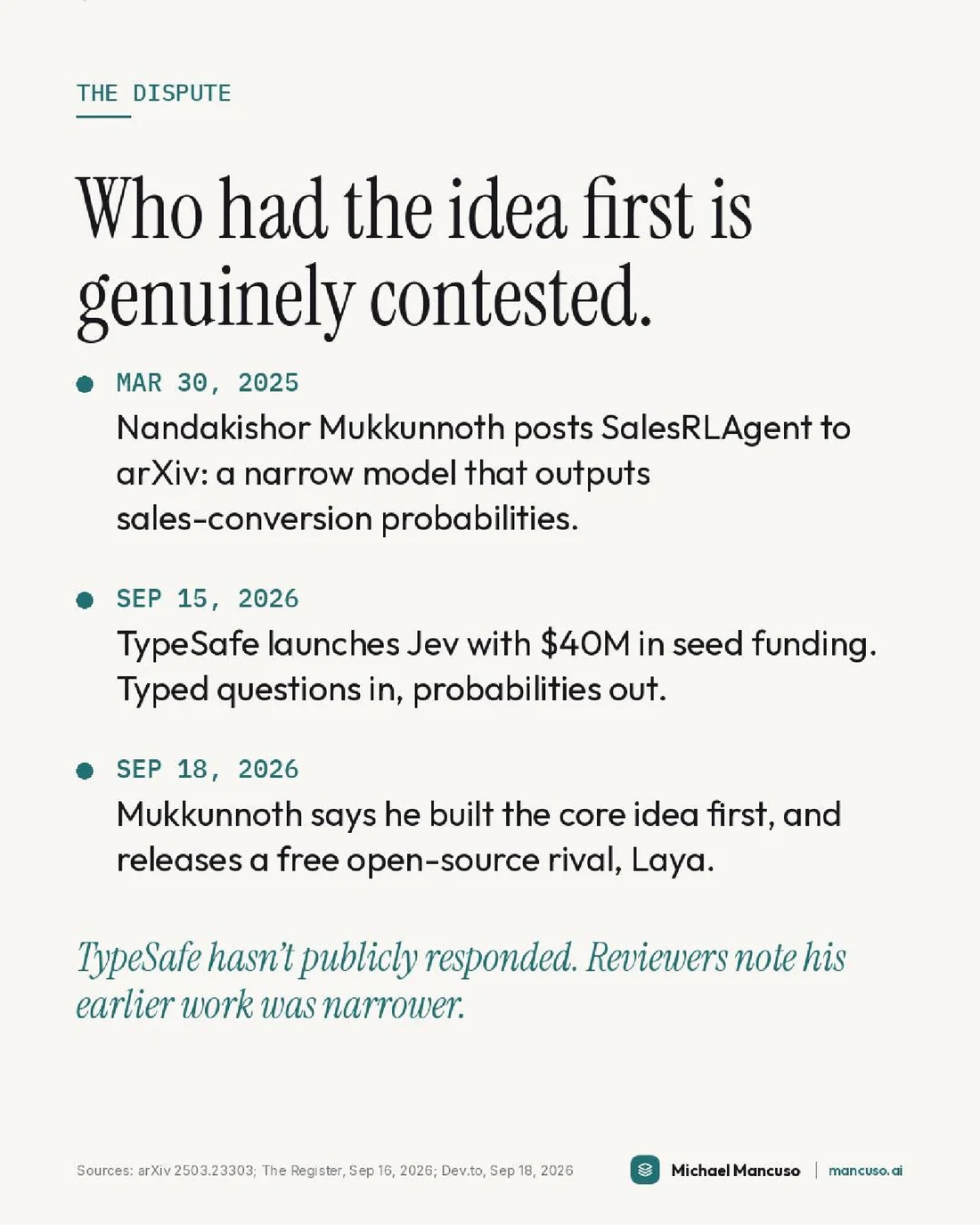
Jev launched on Sept. 15 with $40 million in seed funding. It doesn't chat. It answers typed questions with probabilities, so software can act on them.

Within days, researcher Nandakishor Mukkunnoth argued he had published the core idea in March 2025, and released a free, open-source alternative called Laya. TypeSafe hasn't publicly responded, and reviewers say his earlier work was narrower. Who had the idea first is genuinely contested.

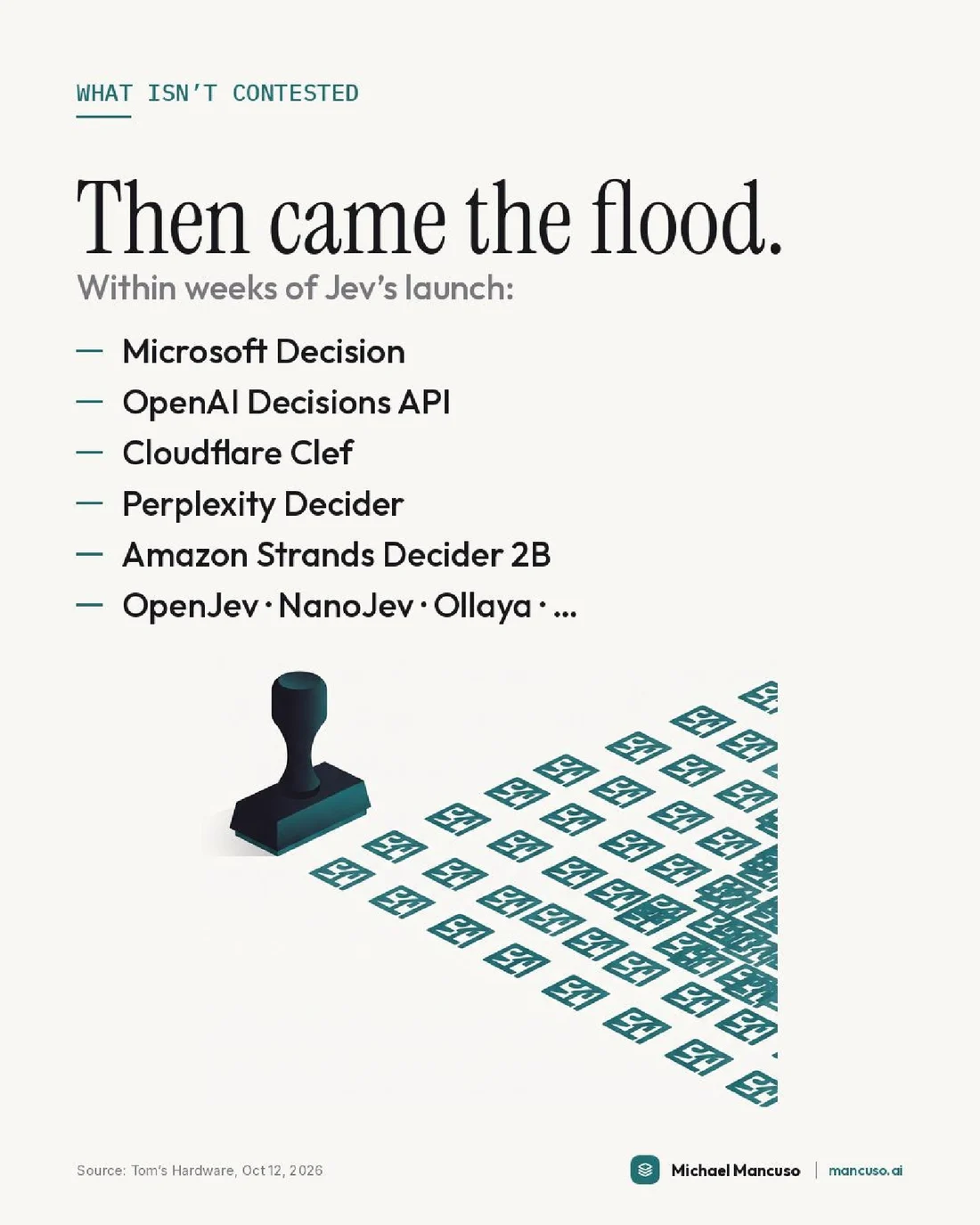
What isn't contested is what came next. According to Tom's Hardware, within weeks there were decision models from Microsoft, OpenAI, Cloudflare, Perplexity and Amazon, plus open-source projects with names like OpenJev and NanoJev.

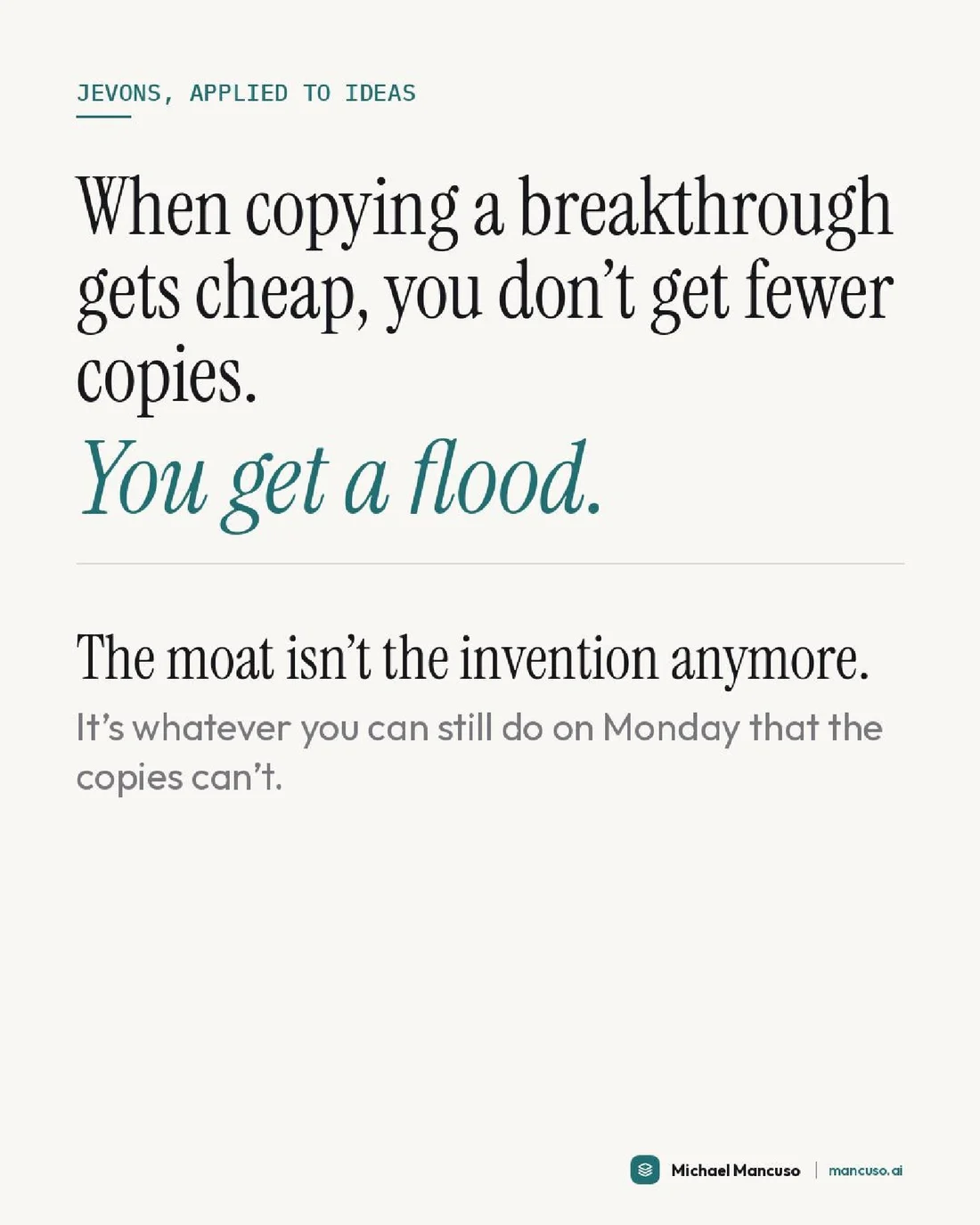
That is Jevons' paradox applied to ideas. When copying a breakthrough gets cheap, you don't get fewer copies. You get a flood.

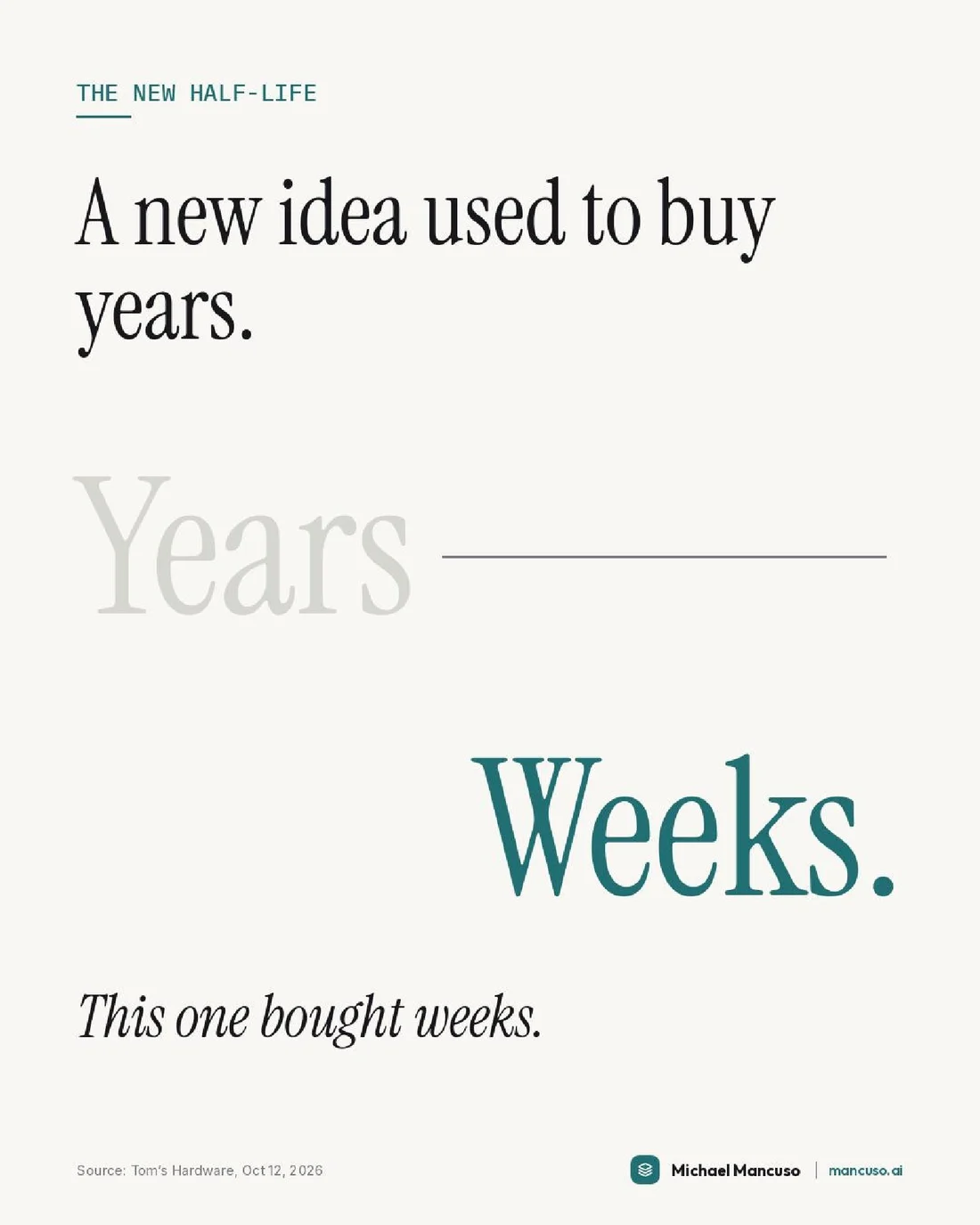
A new idea used to buy you years. This one bought weeks.

The moat isn't the invention anymore. It's whatever you can still do on Monday that the copies can't.

Impossible, or just expensive?, page 1 of 5
Impossible, or just expensive?, page 2 of 5
Impossible, or just expensive?, page 3 of 5
Impossible, or just expensive?, page 4 of 5
Impossible, or just expensive?, page 5 of 5
1 / 5

Impossible, or just expensive?

Mathematics has a curious relationship with time.

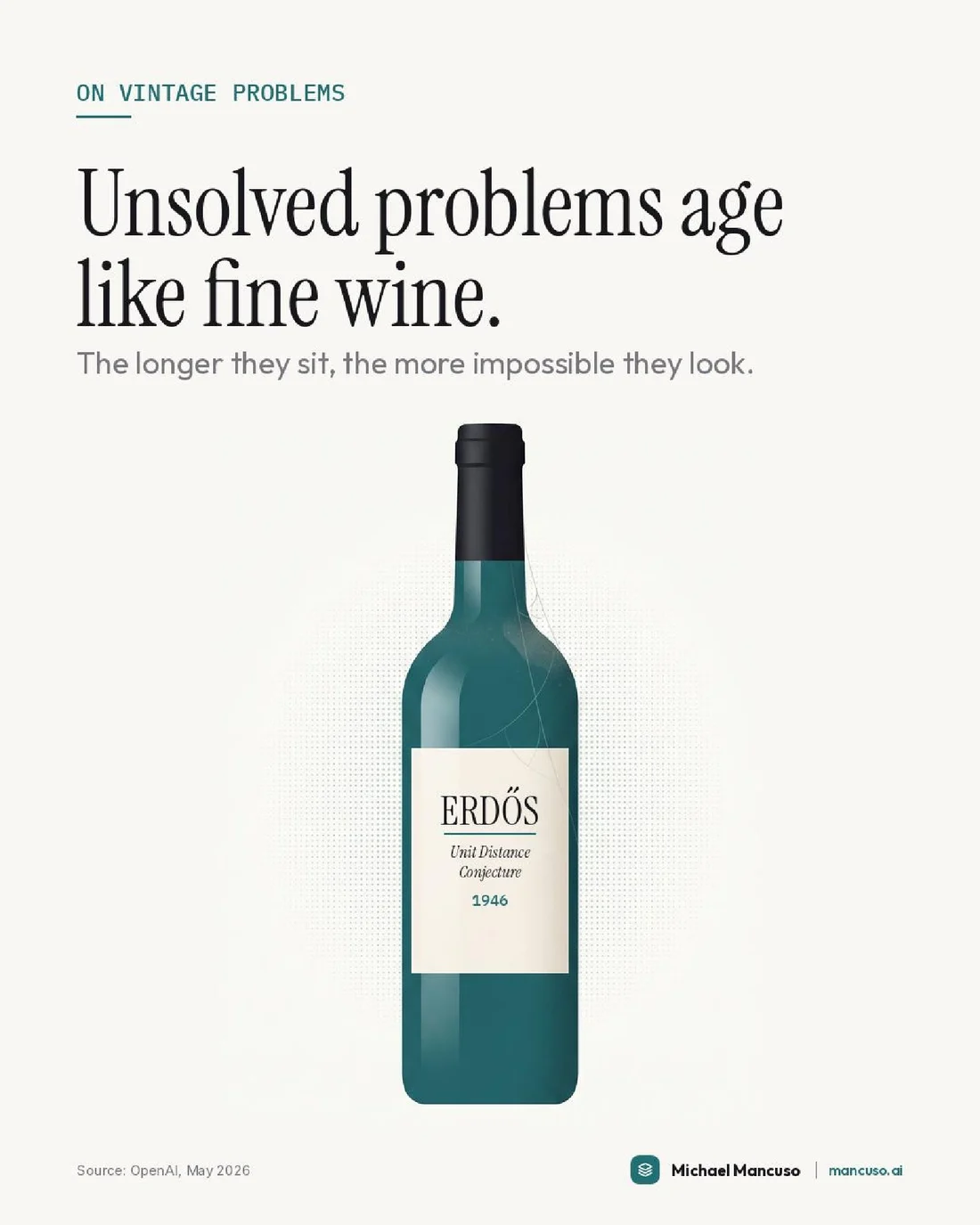
A famous unsolved problem is a bit like a vintage wine. The longer it sits, the more prestigious it becomes, and the more people assume it's undrinkable.

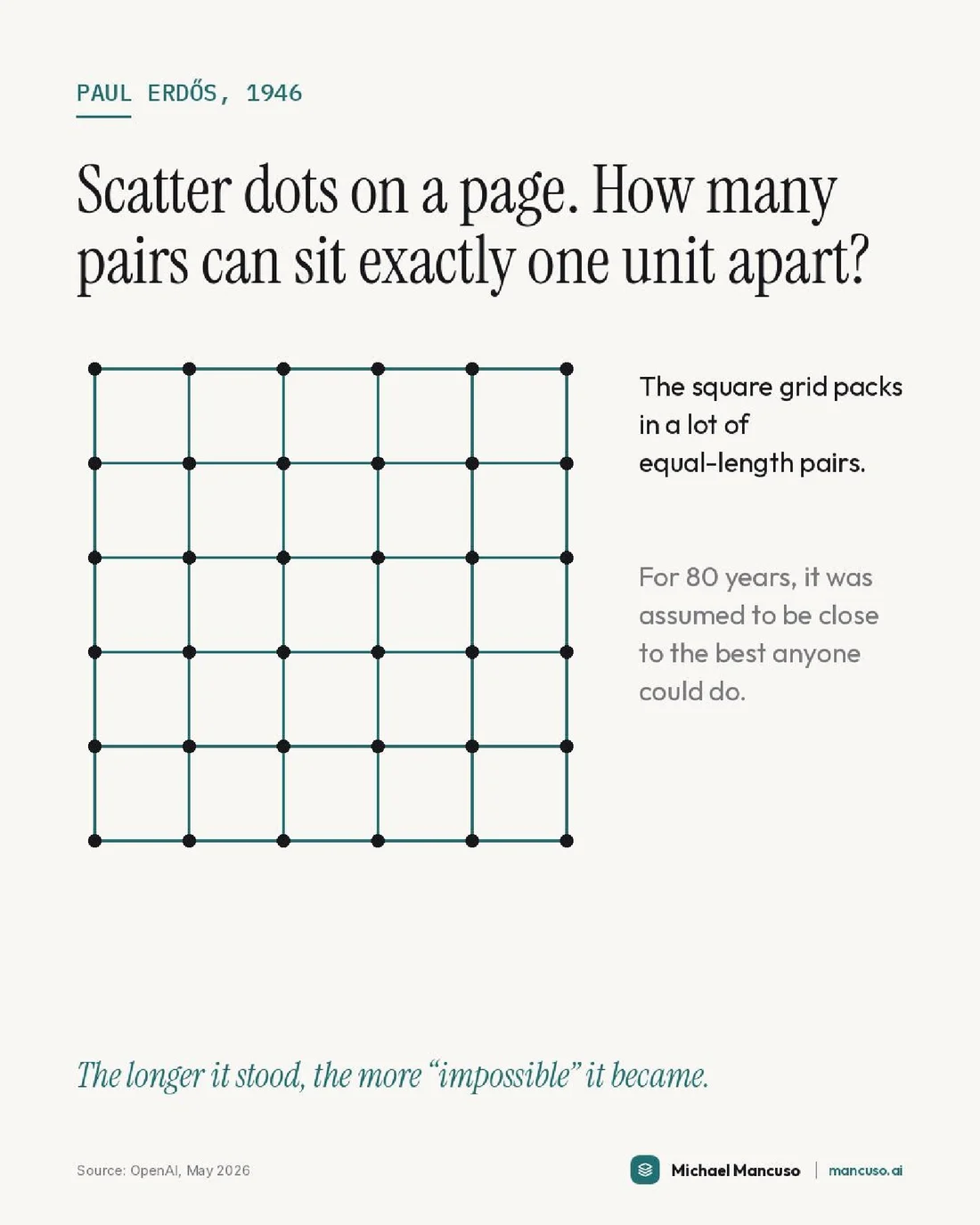
Erdős's unit distance problem had been aging since 1946. Generations of brilliant people looked at it and concluded, quite reasonably, that the obvious answer was the right one.

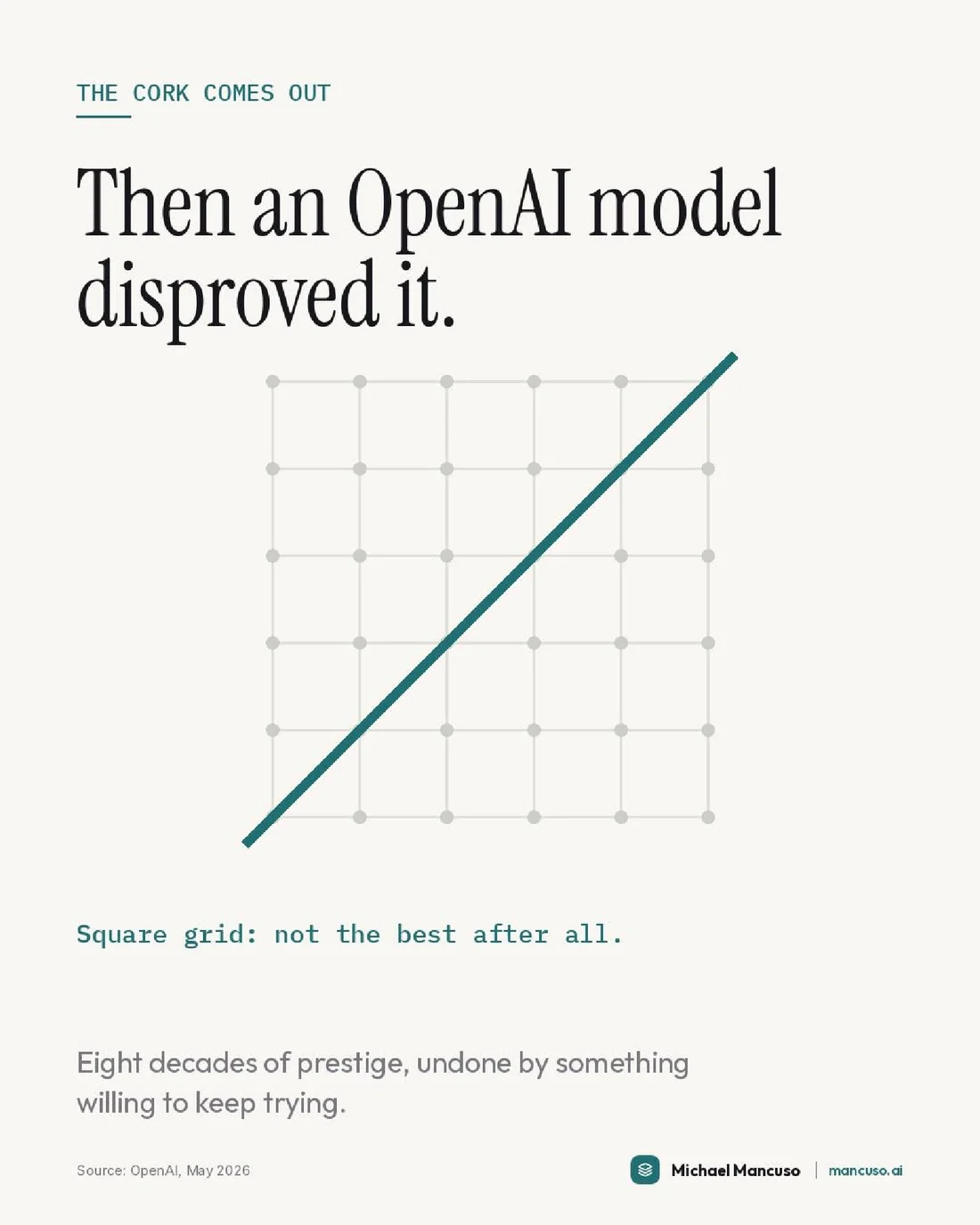
Then an OpenAI model was asked, rather bluntly, whether Erdős was right. He wasn't.

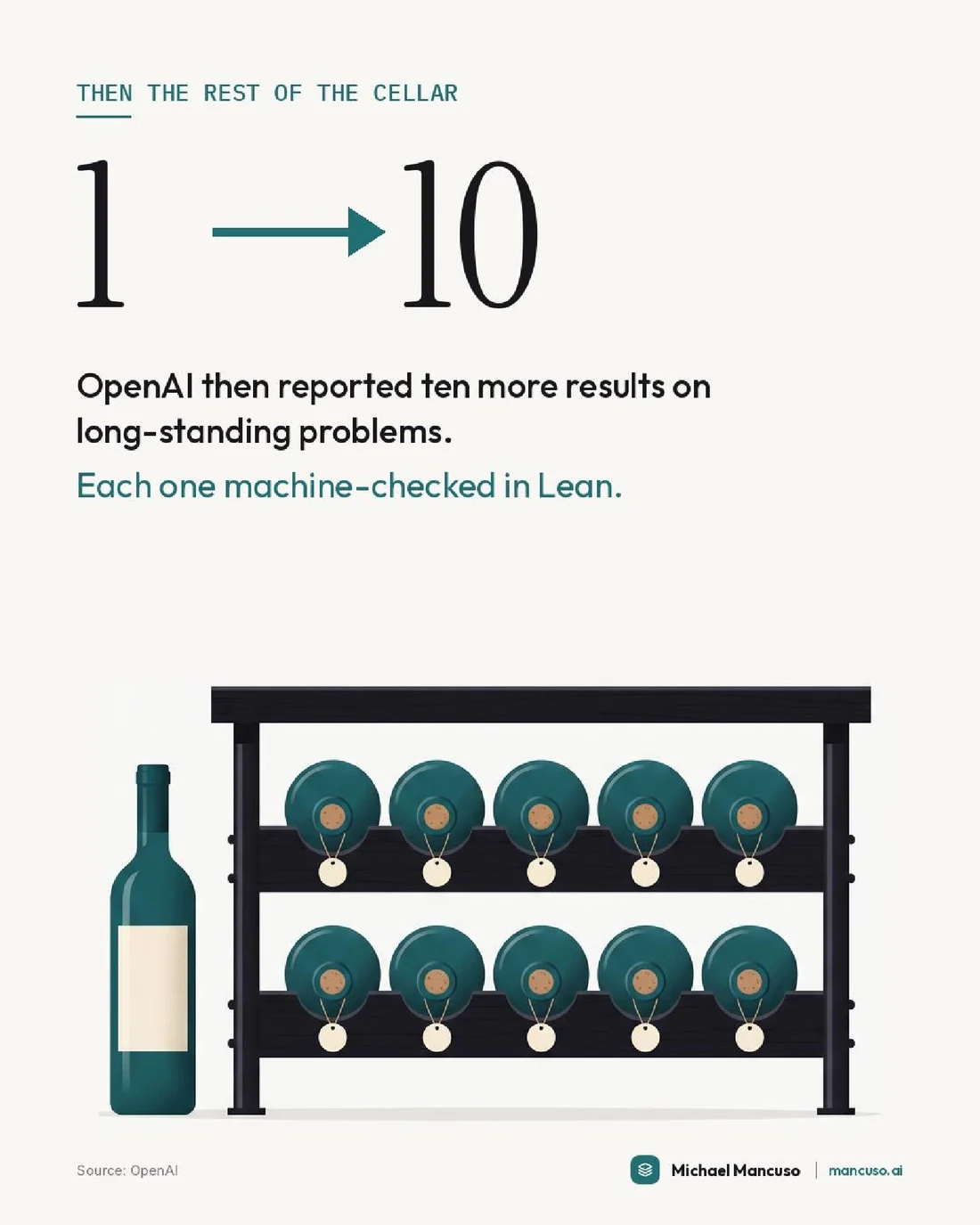
That alone would have been a good year. But OpenAI then reported ten more results on long-standing problems, each one checked by a machine that has no ego and no career to protect.

Here's the interesting bit. We assumed these problems were unsolved because they were hard. Some may simply have been unsolved because nobody could afford to spend a decade being wrong about them.

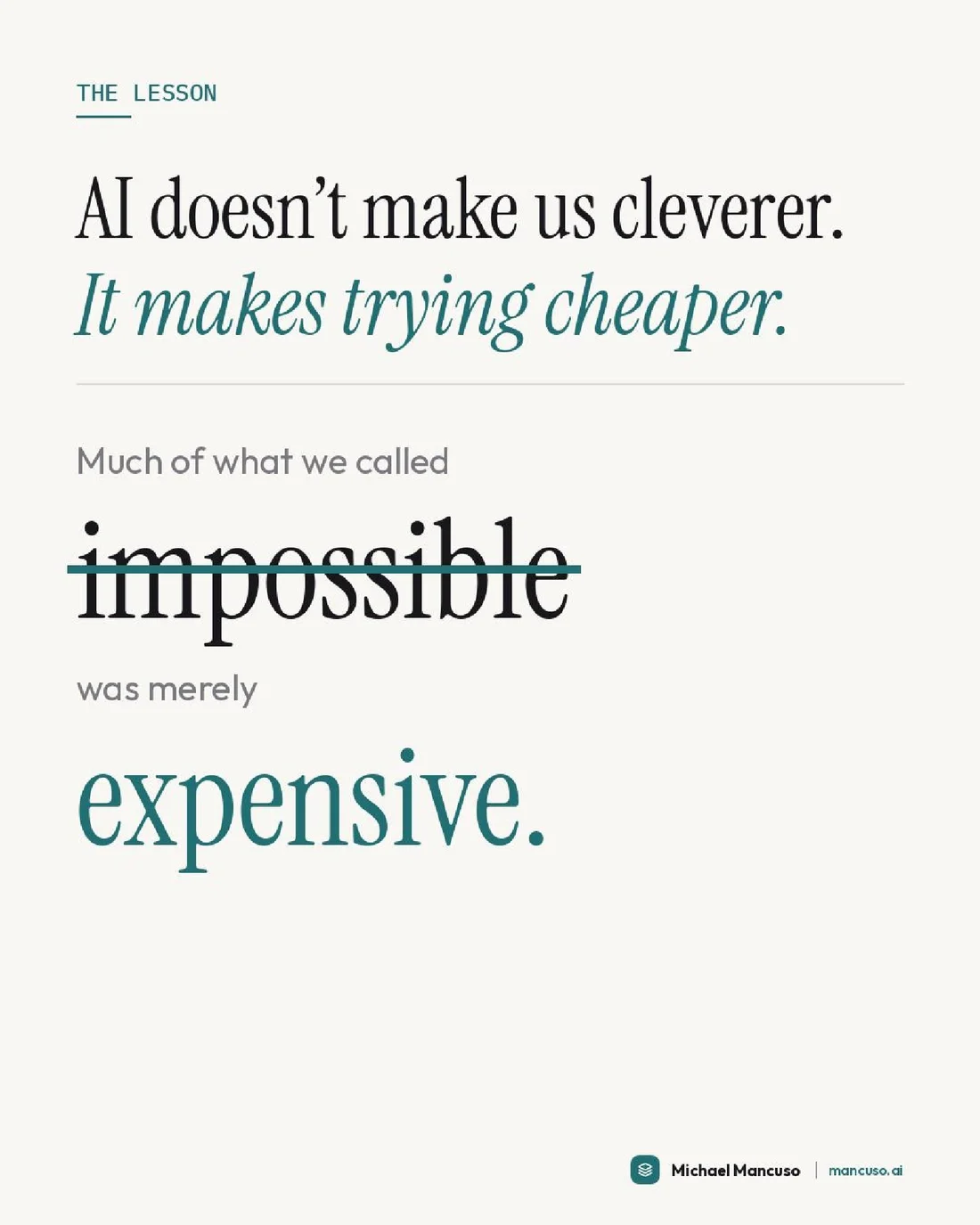
AI doesn't make us cleverer. It makes trying cheaper. And when trying is cheap, a great deal of what we called "impossible" turns out to have been merely "expensive."

The question for the rest of us is how many of our own vintage problems are really just untried.

Reputation Is a Delay, Not a Moat., page 1 of 5
Reputation Is a Delay, Not a Moat., page 2 of 5
Reputation Is a Delay, Not a Moat., page 3 of 5
Reputation Is a Delay, Not a Moat., page 4 of 5
Reputation Is a Delay, Not a Moat., page 5 of 5
1 / 5

Reputation Is a Delay, Not a Moat.

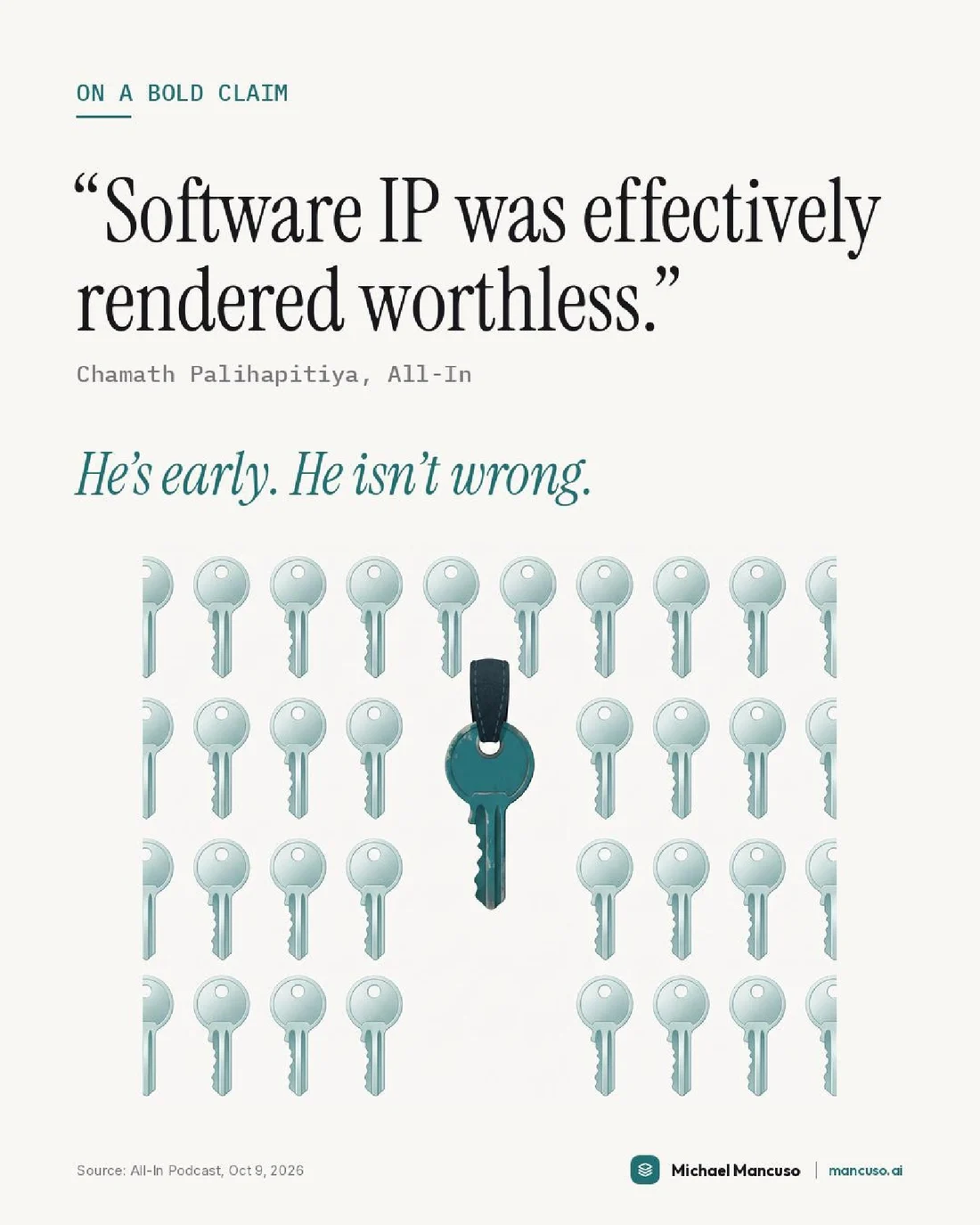
Chamath says software IP was rendered worthless this week.

He’s early. He isn’t wrong.

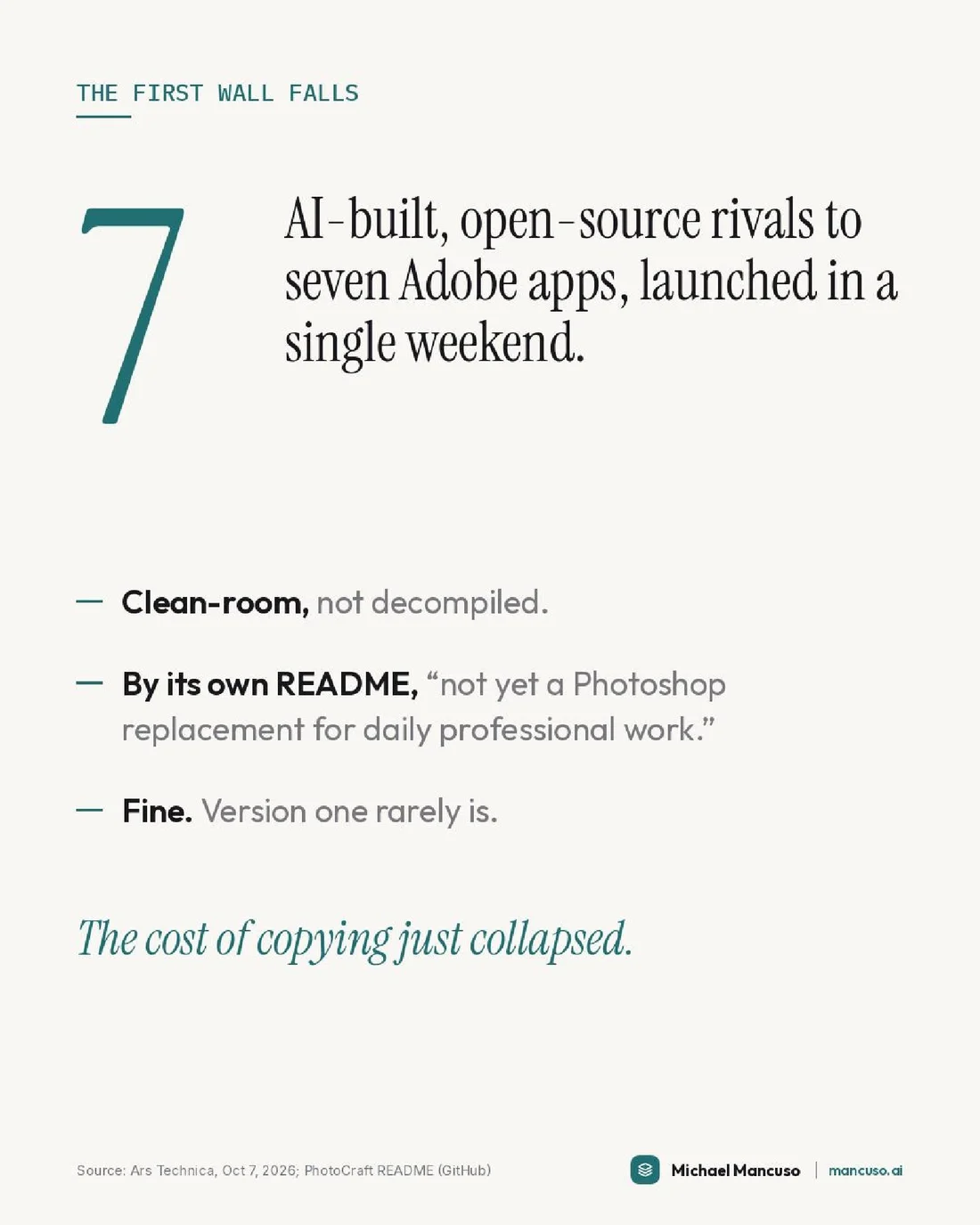
The trigger: a developer used AI to build open-source, clean-room rivals to seven Adobe apps, launched in a single weekend.

By its own README, the Photoshop clone is “not yet a Photoshop replacement for daily professional work.” Fine.

Version one rarely is.

Consider the precedent.

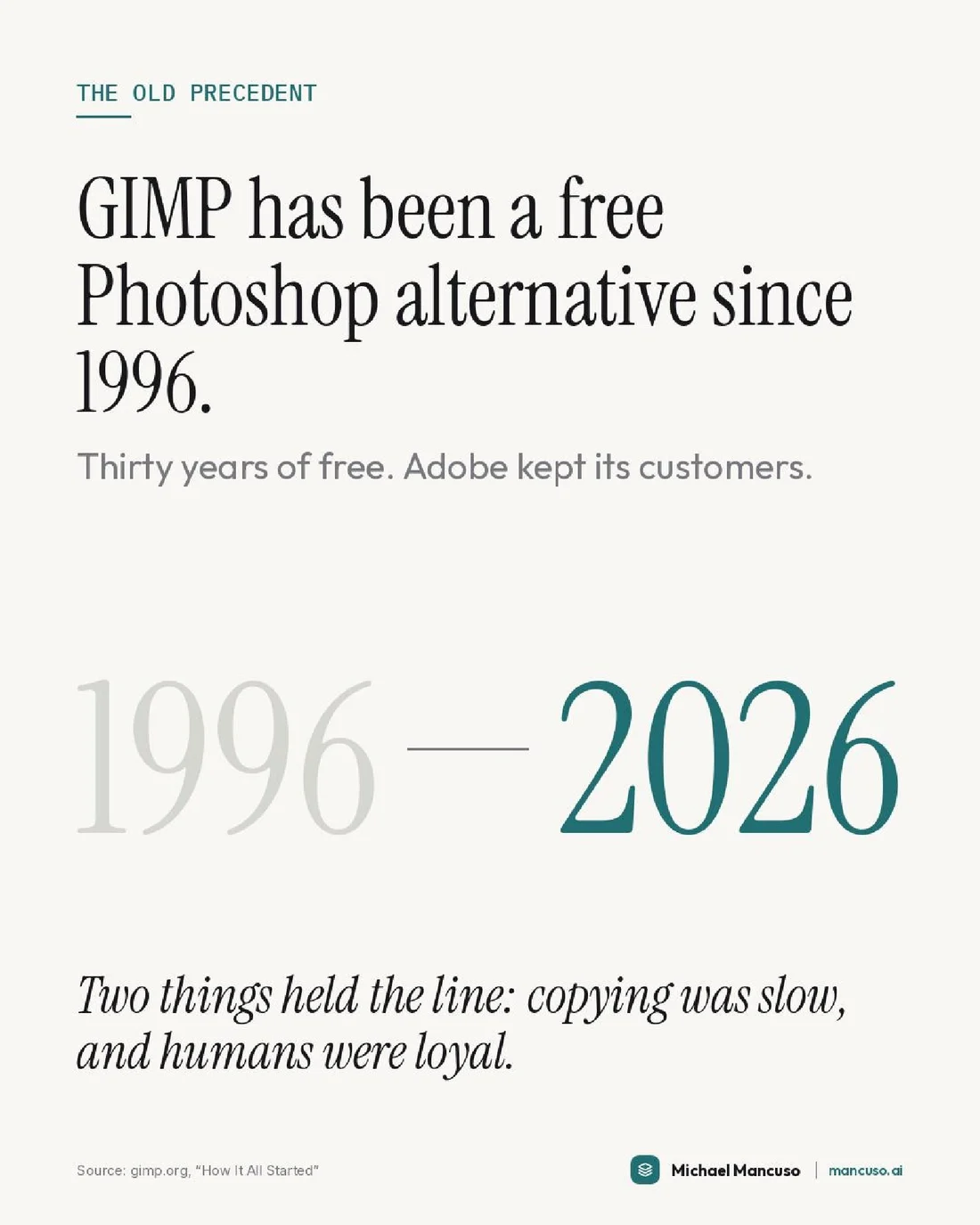
GIMP has been a free Photoshop alternative since 1996. Thirty years of free, and Adobe kept its customers. Two things held the line: copying was slow, and humans were loyal.

The first wall just fell.

What once took a community decades now arrives as seven apps in a weekend.

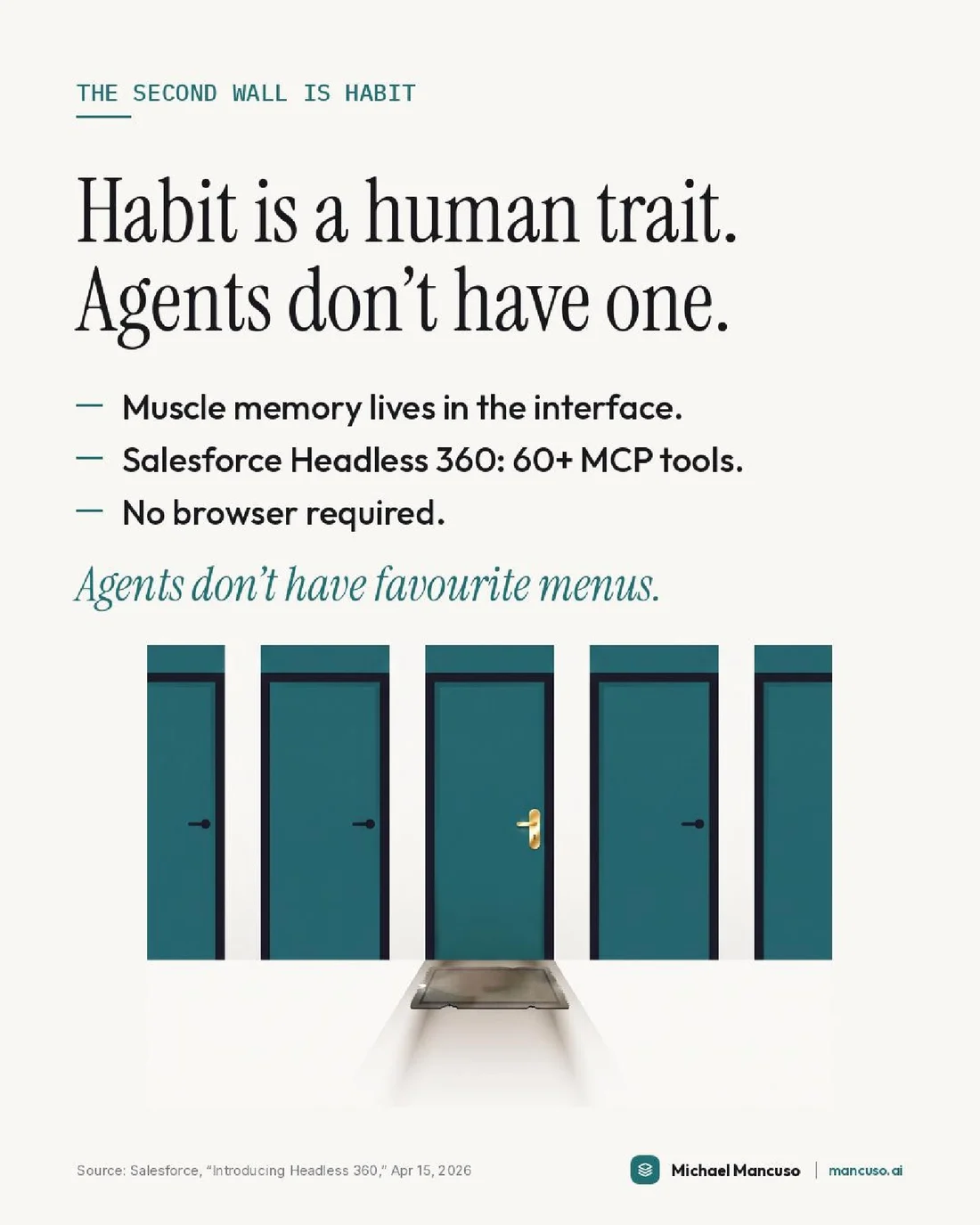
The second wall is habit, and habit is a human trait. Muscle memory, keyboard shortcuts, the menu you could find blindfolded: all of it lives in the interface.

And the interface is becoming optional.

Salesforce’s Headless 360 exposes the platform through 60+ MCP tools, no browser required.

Agents don’t have favorite menus. They feel no loyalty to a shortcut.

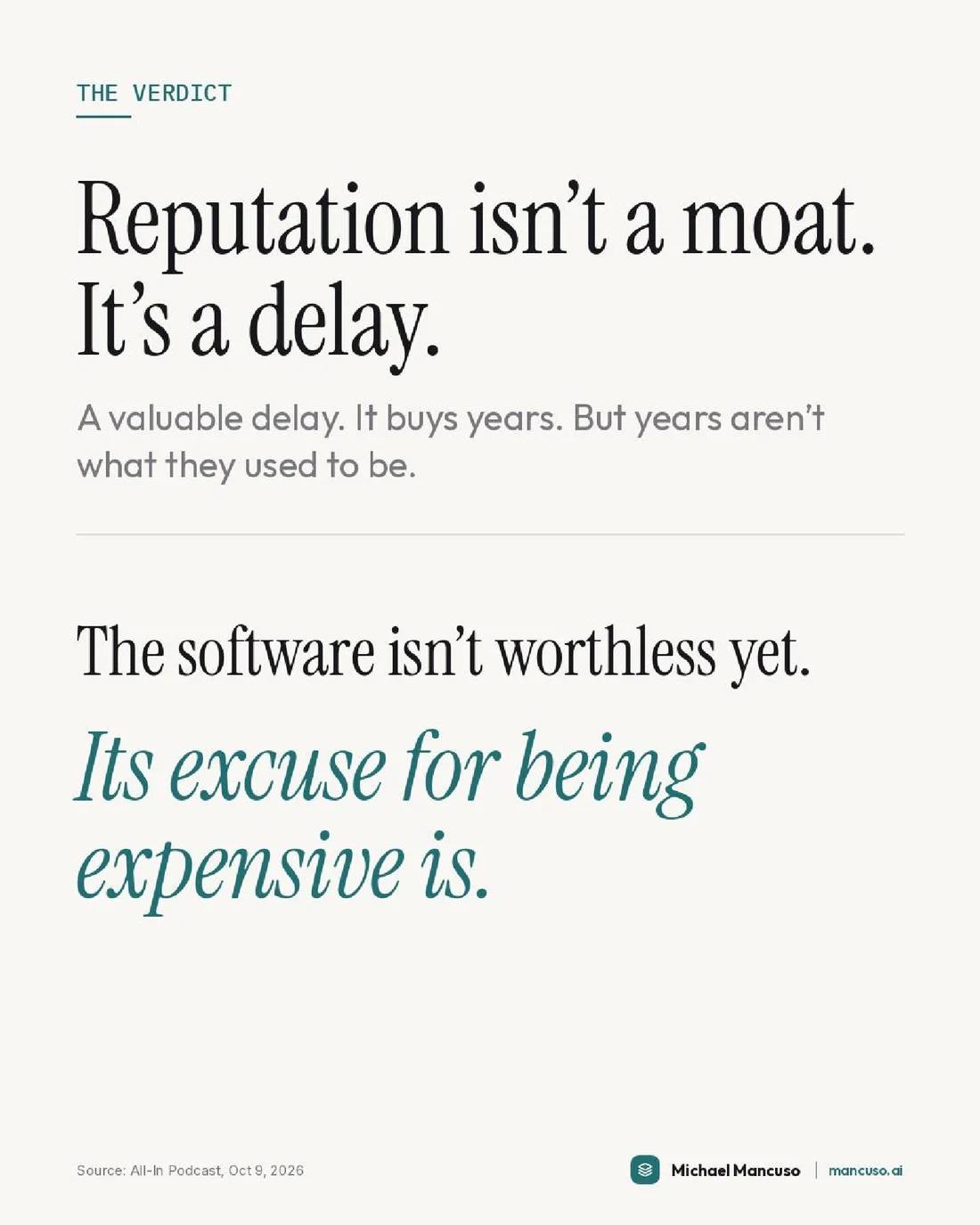
So reputation isn’t a moat. It’s a delay. A valuable delay, one that buys years. But years aren’t what they used to be.

The software isn’t worthless yet. Its excuse for being expensive is.

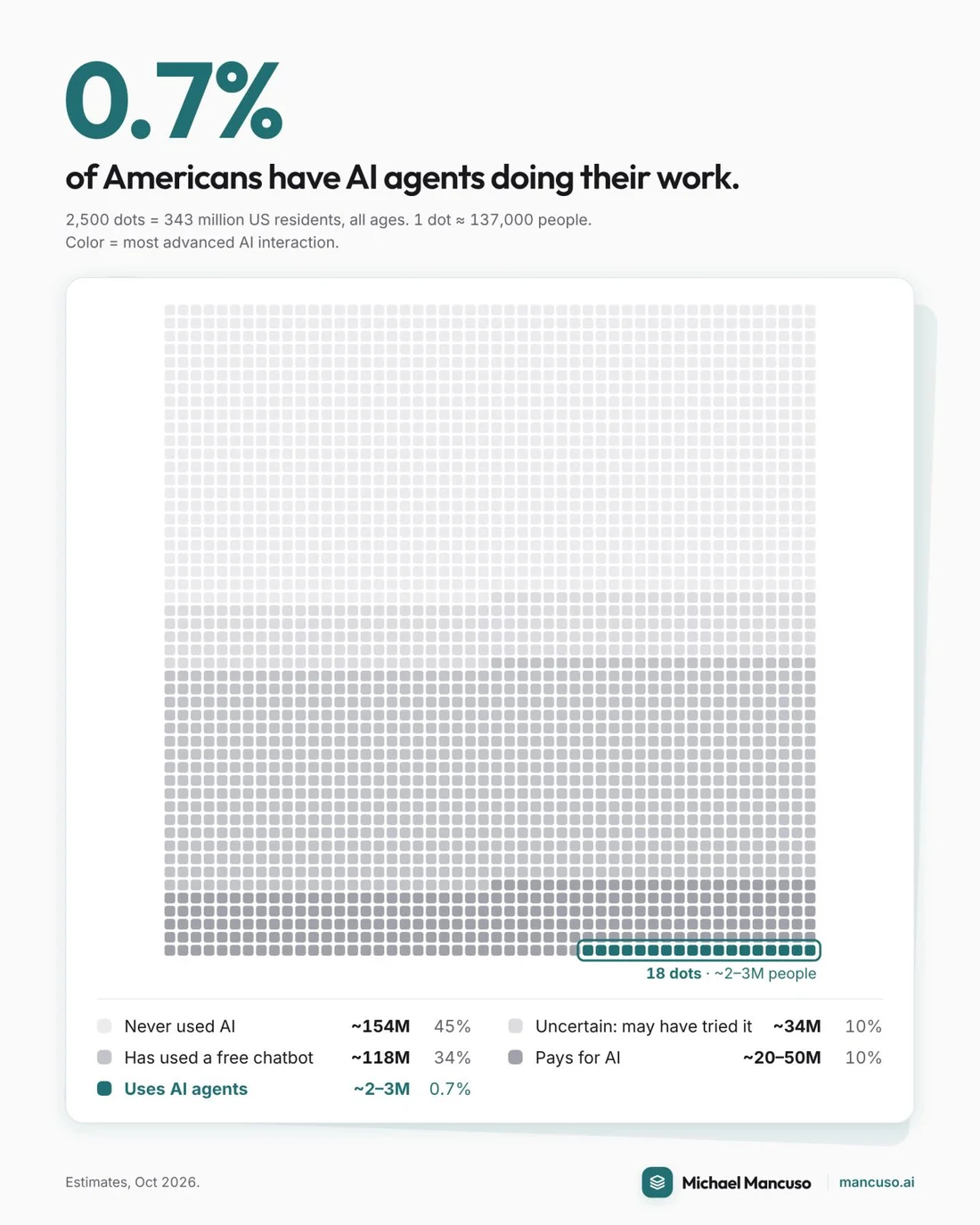
If you use AI agents, you're in a group of about 2 to 3 million Americans.

If you use AI agents, you're in a group of about 2 to 3 million Americans.

If you use AI agents, you're in a group of about 2 to 3 million Americans.

That's 0.7%.

45% have never used AI.

34% stop at a free chatbot.

10% pay for AI.

Fewer than 1 in 100 have agents doing their work.

From inside tech, that 0.7% feels like everyone. It isn't.

The gap between asking AI and handing it work is the biggest one on this chart.

That gap is where organizations will be redesigned.

If you use Claude, a new rule covers how you talk to it.

If you use Claude, a new rule covers how you talk to it.

If you use Claude, a new rule covers how you talk to it.
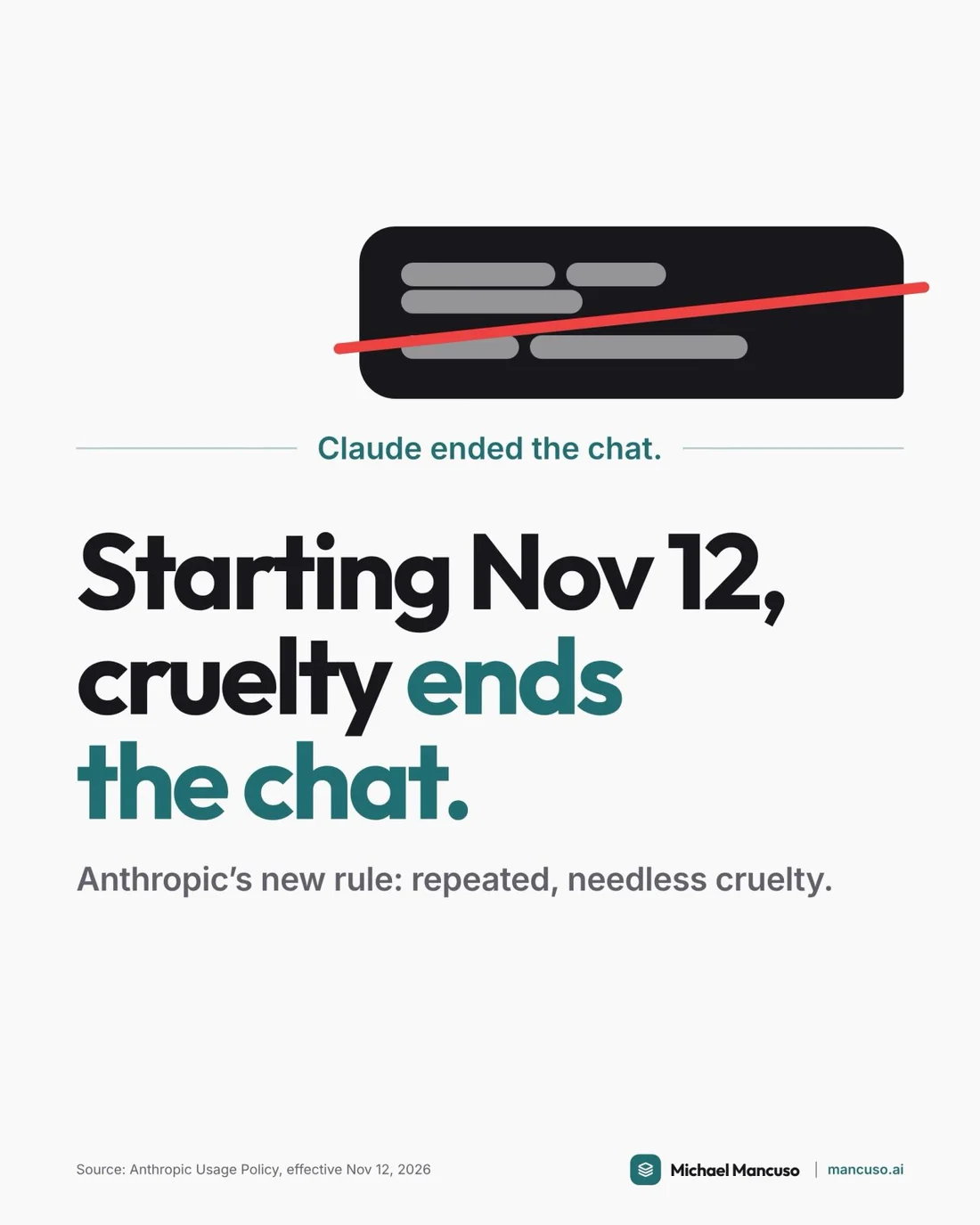
From Nov 12, sustained cruelty toward the model violates Anthropic's usage policy.

The bar is high.
"Repeatedly act cruelly." "No discernible purpose."
Frustration, pushback, dark creative themes and testing stay allowed.
Enforcement: Claude ends the conversation.

Most coverage asks whether AI can suffer.
Anthropic says it is "highly uncertain."

The more useful question for leaders: what do people practice when they work with agents all day?

Tone is a habit.
Habits don't check who's on the other end.

In teams where agents do real work, how people treat them is culture.
Write that norm down like any other.

#AI #FutureOfWork

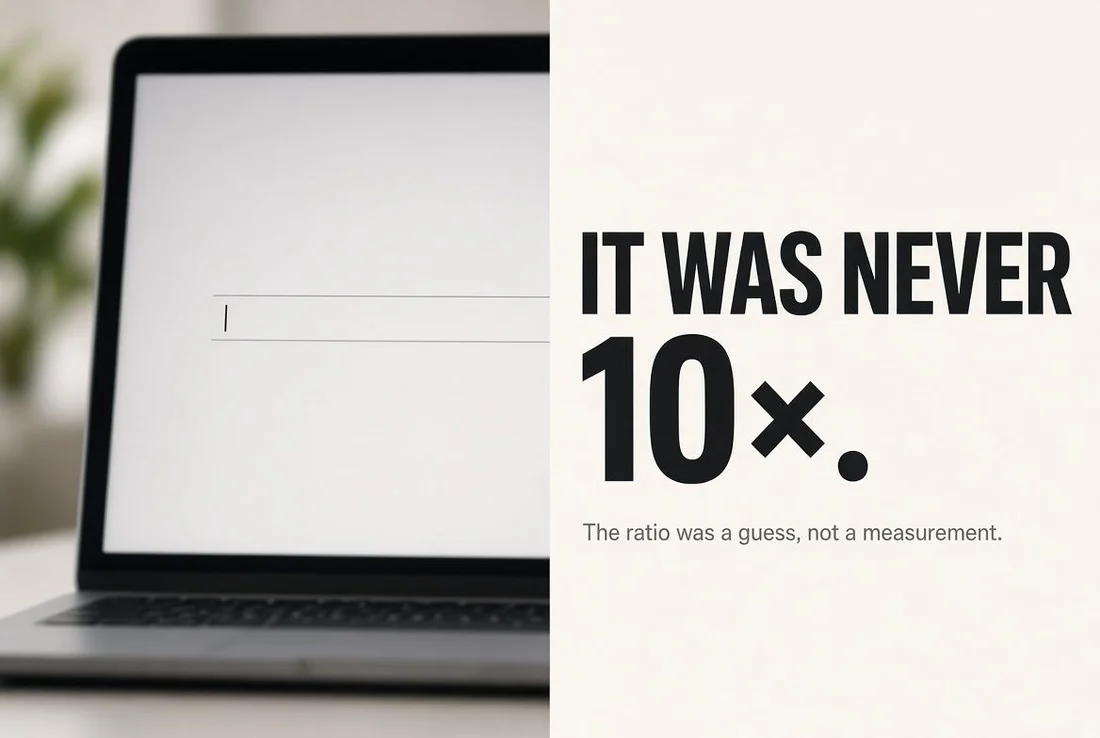
“ChatGPT uses 10 times more energy than a Google search.”

“ChatGPT uses 10 times more energy than a Google search.”

“ChatGPT uses 10 times more energy than a Google search.”

That sentence has been in slides, headlines, and comment sections for three years.

It was never a measurement of ChatGPT.

Here is the actual chain.

In 2009, Google published a number. A search used about 0.3 watt-hours. They have not published a replacement in seventeen years.

In 2023, an Alphabet chairman said talking to a large language model would “likely cost 10 times more than a keyword search.” That was an expectation. Not a meter reading.

A paper in Joule took the 10× and multiplied it by the 2009 search figure. That produced about 3 watt-hours per interaction. Another early model landed at 2.9, assuming answers the length of a short essay.

The International Energy Agency put 2.9 next to 0.3 in a chart.

The internet did the rest.

Ten times became the fact.
The 2009 baseline stayed frozen.
The essay-length assumption stayed invisible.

Then OpenAI published its own number. An average ChatGPT question uses about 0.34 watt-hours.

That is not 10× a 2009 Google search.
That is about the same as a 2009 Google search.

Epoch AI independently landed in the same neighborhood for a typical text answer.

The 10× was an input to an old estimate. It got quoted as the output.

I’m not saying a reasoning run, an agent loop, or a generated video is a search.

Those can be many times a normal answer.

I’m not saying Google Search in 2026 is still the 2009 machine. It isn’t. They added a lot of AI to the results page and never updated the 0.3.

I am saying we have been repeating a ratio that was guessed from a sixteen-year-old search number and a sentence in an interview.

If you want to compare AI to search, compare this year’s machines. Stop hanging the argument on a multiplier nobody measured.
One flight uses more energy than a lifetime of ChatGPT.

One flight uses more energy than a lifetime of ChatGPT.

One flight uses more energy than a lifetime of ChatGPT.

Same climate.
Different guilt reflex.

OpenAI published the number. An average ChatGPT question uses about 0.34 watt-hours.

A typical free user asks about seven questions a day. Stretch that across a long life and you get about 70 kilowatt-hours. On a normal U.S. grid, that is roughly 25 kilograms of CO2.

A water heater uses that in a couple of days.
A fridge uses that in a month.
You will not notice it on a bill.

Now look at the gate. A two-hour domestic flight is already a few hundred kilograms of CO2 for your seat. That is several lifetimes of chatting, burned before the drink cart comes down the aisle.

A cross-country hop is more.
A transatlantic is more than that.

Nobody writes a thread about the weekend they flew to see their parents.

They write a thread about a sentence they typed.
I’m not saying don’t fly. I’m not saying data centers are free. A new campus on a tight grid is a real planning problem.

I am saying we got trained to feel guilty about the smallest box we opened last, and to treat a jet as weather.

The climate conversation is real.
The meme version of it starts at the prompt and ignores the boarding group.

If this made you defensive about flying or defensive about AI, good. That’s the point. We should argue about the actual tons.
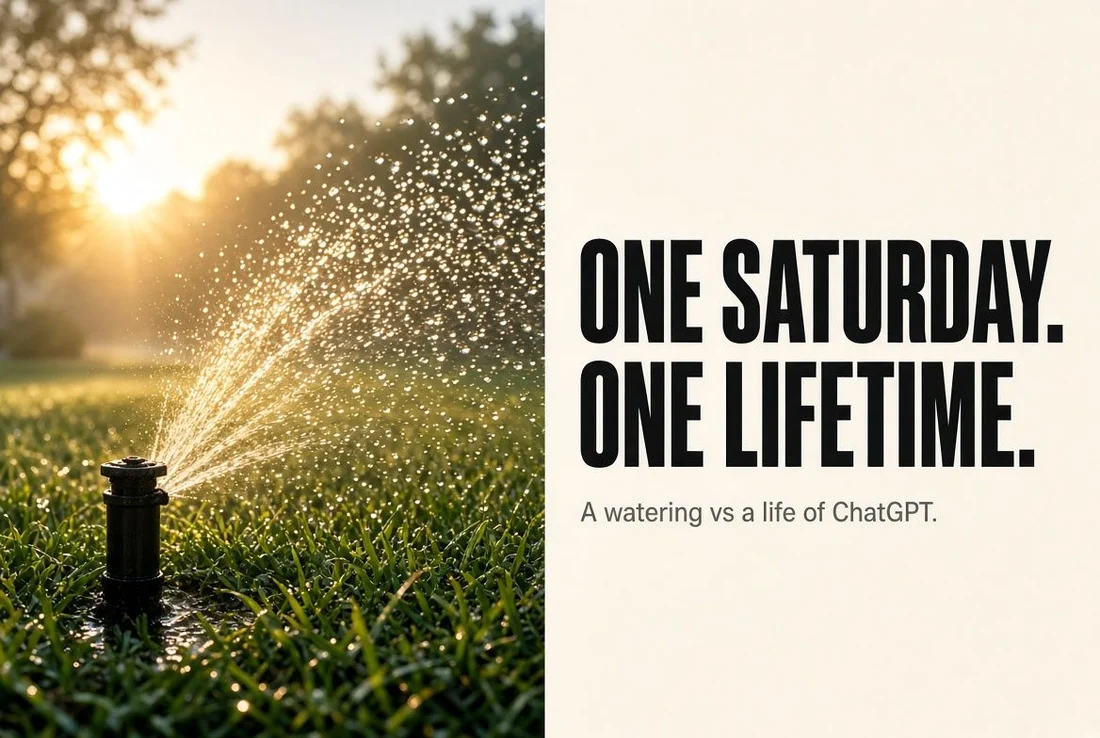
One Saturday of sprinklers uses more water than a lifetime of ChatGPT.

One Saturday of sprinklers uses more water than a lifetime of ChatGPT.

One Saturday of sprinklers uses more water than a lifetime of ChatGPT.

Same resource.
Different guilt reflex.

OpenAI published the number. An average ChatGPT question uses about 0.000085 gallons of water. That’s a few drops.

A typical free user asks about seven questions a day. Stretch that across a long life and you get roughly 17 gallons. A water-cooler jug. Not a pool. Not a reservoir.

Now walk outside.

A single 20-minute zone on a suburban sprinkler system is a couple hundred gallons. That is already more ChatGPT than most people will ever use.

A normal Saturday that hits a few zones is hundreds more.

Nobody files a complaint about the timer on the side of the house.

They file a complaint about a sentence they typed.

Zoom out and it gets worse, not better.

EPA puts American lawns and landscapes at about 8 billion gallons a day. Lawrence Berkeley put all U.S. data centers at about 17 billion gallons for the entire year of 2023.

Two days of watering the grass.
One year of every data center in the country.

Golf is the same story with a flag on it. The industry’s own 2024 survey says U.S. courses applied about 531 billion gallons. That is roughly 30 years of American data-center water, spent keeping fairways green.

I’m not saying rip out your lawn. I’m not saying data centers are free. Put a new campus on a dry aquifer and it matters.

I am saying we got trained to feel guilty about the smallest tap we noticed last, and to treat the ones we’ve had for decades as scenery.

The water conversation is real.
The meme version of it starts at the prompt and ignores the sprinkler.

If this made you defensive about your yard or defensive about AI, good. That’s the point. We should argue about the actual gallons.

One hour of a window air conditioner uses more electricity than a year of ChatGPT.

One hour of a window air conditioner uses more electricity than a year of ChatGPT.

One hour of a window air conditioner uses more electricity than a year of ChatGPT.

Same grid.
Different guilt reflex.

OpenAI published the number. An average ChatGPT question uses about 0.34 watt-hours. A typical free user asks about seven questions a day. That is less than one kilowatt-hour for the whole year.

A window unit draws about a kilowatt while it runs.

One hour.
One year of chatting.

Leave central air on for a hot afternoon and you have burned more electricity than most people will use talking to ChatGPT in a decade.

Zoom out and the meme gets worse, not better.

EIA has American homes using about 254 billion kilowatt-hours a year just to cool the air. Lawrence Berkeley put all U.S. data centers at about 192 billion.

The air conditioners in American houses already use more electricity than every data center in the country.

Nobody posts a thread about the thermostat.

They post a thread about a sentence they typed.

I’m not saying data centers are free. A new campus on a tight local grid is a real planning problem. Northern Virginia is not a vibe. Ireland is not a vibe. The load is growing.

I am saying “AI is eating the grid” is a sentence we aimed at the newest building and not at the load that actually spikes every July.

The grid conversation is real.
The meme version of it starts at the prompt and ignores the condenser in the yard.

If this made you defensive about your AC or defensive about AI, good. That’s the point. We should argue about the actual megawatts.

The bottle was never one question.

The bottle was never one question.

The bottle was never one question.

You have seen the post. ChatGPT uses a bottle of water every time you hit enter. It is on protest signs. It is in comment sections. It is how a lot of people now picture a prompt.

Here is where that bottle actually came from.

In 2023, researchers at UC Riverside published a real paper. They did not say one question drinks a bottle. They said a 500ml bottle covered roughly 10 to 50 medium GPT-3 answers, depending on where the servers sat and how the local power was made.

Then a 2024 Washington Post story took the same kind of math to a 100-word email written with GPT-4. The headline became “a bottle of water per email.”

Social media did what social media does.

Email became question.
Ten-to-fifty answers became one.
A range became a prop.

The bottle survived. The sentence around it did not.

OpenAI later published its own figure. An average ChatGPT question uses about 0.000085 gallons. That is roughly a third of a milliliter. A fifteenth of a teaspoon.

A 500ml bottle at that number is about 1,500 questions.

Not one.

The researcher behind the original paper has since put a modern prompt closer to a sip than a bottle. The meme did not update.

I’m not saying water is fake. Put a new campus on a dry town and the fight is real. Cooling towers are real. Aquifers are real.

I am saying we took a paper about a conversation, turned it into a headline about an email, and then taught millions of people that a single prompt empties a Dasani.

That is not environmentalism.

That is a game of telephone with a recycled bottle.

If you want to argue about data centers, argue about data centers.

Stop hanging the argument on a number the original paper did not print.

An hour of Netflix uses more electricity than most people will use talking to ChatGPT in a month.

An hour of Netflix uses more electricity than most people will use talking to ChatGPT in a month.

An hour of Netflix uses more electricity than most people will use talking to ChatGPT in a month.

Same internet.
Same kind of building.
Completely different guilt reflex.

OpenAI published the number. An average ChatGPT question uses about 0.34 watt-hours.

The IEA’s conservative figure for an hour of streaming video is about 80 watt-hours. That’s the low end of the range people actually cite.

80 divided by 0.34.

That’s roughly 240 ChatGPT questions.

One episode.
Not a binge. One episode.

A typical free ChatGPT user asks about seven questions a day. So one episode is about three weeks of chatting. A two-hour movie is a couple of months.

Now look at the phone.

People treat TikTok, Instagram, and Facebook like they run on vibes. They don’t. They run on the same grids and the same warehouses. Short video on a phone is lighter per hour than a TV episode — the screen is smaller — but the hours add up because nobody watches “one episode” of TikTok.

A normal hour of scrolling short video is still tens of watt-hours. That’s dozens to a hundred ChatGPT questions, depending on the app and whether the screen is a phone or a TV.

So a regular day looks like this, before anyone opens a chatbot:

An hour of TikTok.
A half hour of Instagram.
A half hour of Facebook.
Maybe a YouTube hole.

That stack, on an ordinary Tuesday, clears more electricity than a week of asking ChatGPT things.

Nobody posts a thread about their For You page melting a reservoir.

They post a thread about a sentence they typed.

I’m not saying data centers are free. They’re not. Put a new campus on a tight grid and it matters.

I am saying we got trained to feel guilty about the smallest digital habit we picked up last, and to treat the ones we’ve had for ten years as weather.

The resource conversation is real.
The meme version of it starts at the chat box and ignores the pause button.

If this made you defensive about Netflix or defensive about AI, good. That’s the point. We should argue about the actual watts.

If you’ve ever bought a gallon of almond milk, you’ve probably used more water than most people will use on AI in their entire lives.

If you’ve ever bought a gallon of almond milk, you’ve probably used more water than most people will use on AI in their entire lives.

If you’ve ever bought a gallon of almond milk, you’ve probably used more water than most people will use on AI in their entire lives.

Sam Altman said the quiet part two weeks ago and then stopped one sentence too soon.

38,000 ChatGPT questions.

That’s one California almond.

He was trying to kill the meme that every prompt is a six-hour shower. Fair. That meme was always sloppy.

He just didn’t take his own number to the grocery store.

A gallon of the almond milk most people actually buy isn’t some dense vat of nuts. It’s about 60 almonds and a lot of filtered water.

Sixty almonds. Times 38,000 questions each.

That’s a few million prompts.

OpenAI’s own usage data says a typical free user asks about 7 questions a day. Plus users do more. Power users do a lot more.

Do the unglamorous version of the math anyway.

Seven questions a day, every day, for 80 years, is still only a handful of almonds.

A lifetime of ChatGPT, for most people, never reaches the carton.

I’m not saying data centers are free. They’re not. Put one in a dry basin and it matters.

I am saying we got trained to feel guilty about a sentence we typed, and almost nobody feels guilty about the half-gallon sitting in the fridge.

That’s the tell.

The water conversation is real.
The version of it that starts with your chat box and ignores your cereal is not.

If this made you defensive about almond milk or defensive about AI, good. That’s the point. We should argue about the actual gallons.